
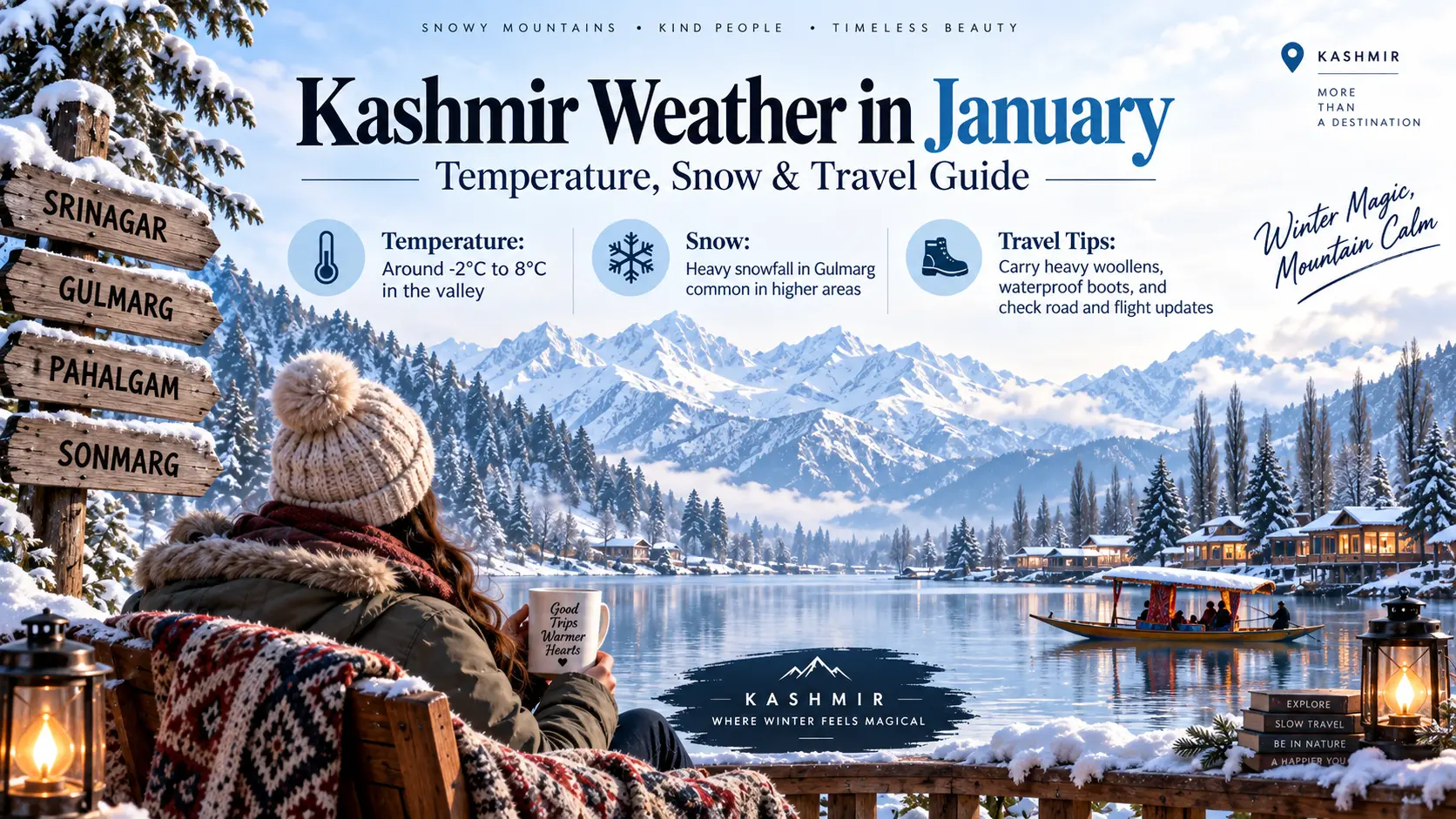
Kashmir Weather in January: Temperature, Snow & Travel Guide
- Kashmir weather in January is cold, distinctly wintry and strongly influenced by altitude. Srinagar experiences freezing or near-freezing nights, while higher destinations such as Gulmarg are generally colder and have a much stronger snow character. January also overlaps with Chillai Kalan, traditionally regarded as the harshest 40-day phase of Kashmir’s winter.
- For travellers, however, “Kashmir weather” is too broad to describe with one temperature.
- Srinagar, Gulmarg, Pahalgam and Sonamarg sit at different elevations and can experience very different conditions on the same day.
- January is particularly attractive if your idea of Kashmir includes snow-covered mountains, winter landscapes and skiing around Gulmarg. It is less suitable if you expect every sightseeing road to operate like it does in summer.
- Historical climate modelling used by WeatherSpark puts Srinagar’s January average daily high at around 49°F (9°C) and average low at about 28°F (-2°C). These are historical averages, not a forecast for your travel dates. Actual January conditions can be warmer or considerably colder.
- The right way to plan a Kashmir trip in January is therefore to combine winter expectations with flexibility.
Kashmir Weather in January at a Glance
Question | Practical Planning Answer |
Is January cold in Kashmir? | Yes, it is one of the core winter months |
Srinagar historical average high | Around 9°C |
Srinagar historical average low | Around -2°C |
Can nights fall below freezing? | Yes |
Can it snow in Srinagar? | Yes, but not every day |
Better snow destination | Gulmarg |
Can fresh snowfall be guaranteed? | No |
Is skiing possible? | Commonly associated with Gulmarg’s winter season, subject to snow and operations |
Is Pahalgam cold? | Yes |
Is Sonamarg access guaranteed? | No; winter access must be checked |
Does January overlap Chillai Kalan? | Yes |
Are winter roads always predictable? | No |
Should itineraries have flexibility? | Yes |
WeatherSpark’s historical dataset also identifies January as Srinagar’s coldest month by average low temperature.
The numbers are useful for packing, but they should not be mistaken for a day-by-day forecast.
Kashmir Temperature in January
- January sits deep inside Kashmir’s winter.
- In Srinagar, historical climate data show average daily highs around 9°C and lows around -2°C. WeatherSpark notes that January lows can occasionally fall considerably below that average.
- Higher destinations can feel much colder.
- This is why an article claiming something like “Kashmir is -7°C to 7°C in January” oversimplifies the region.
- A temperature measured in Srinagar does not tell you what you will experience higher in the mountains around Gulmarg.
- Similarly, conditions during a clear sunny afternoon can feel completely different from early morning or after sunset.
Kashmir Weather in January: Day and Night
- The difference between daytime and nighttime matters when packing.
- During a clear winter day in Srinagar, sunshine can make sightseeing more comfortable than the thermometer initially suggests.
- Once the sun disappears, temperatures can drop quickly.
- You should therefore dress in removable layers rather than relying on one extremely heavy jacket.
- A practical combination is:
- Thermal base layer → sweater or fleece → insulated outer jacket.
- Add gloves, warm socks and suitable footwear according to conditions.
- The same clothing strategy is particularly useful if you move between Srinagar and higher locations.
Srinagar Weather in January
- Srinagar provides a useful base for a winter Kashmir holiday because it offers accommodation, Dal Lake, local sightseeing and onward access to other destinations.
- January is cold.
- Historical climate modelling puts the average Srinagar January temperature at roughly 3°C overall, with average highs around 9°C and lows around -2°C.
- That does not mean every January day follows this pattern.
- Cold spells can take temperatures below the averages, while some sunny afternoons can feel noticeably milder.
- Snowfall is also variable.
- Srinagar may receive fresh snow during your stay, but a January booking does not guarantee that snow will fall while you are physically standing in the city.
- WeatherSpark’s historical modelling identifies the Srinagar snow season as roughly December into February and January as the month with the highest average snowfall in its Srinagar dataset.
- This is useful climatology, not a prediction of a particular January.
Does It Snow in Kashmir in January?
Yes, snowfall is part of Kashmir’s January weather pattern, particularly at higher elevations.
But there is an important difference between:
snow on the ground
and
snow falling from the sky during your holiday.
Gulmarg may have substantial existing snow even when no fresh snow falls during your exact stay.
Srinagar may be cold but relatively dry for several days before a weather system brings precipitation.
That distinction matters when someone asks:
“Will I definitely see snowfall if I visit Kashmir in January?”
You may have good opportunities to see winter snow, especially by including higher destinations such as Gulmarg.
You cannot responsibly be promised fresh snowfall on a specific holiday date months ahead.
Snowfall in Kashmir January Dates
- There are no fixed annual snowfall in Kashmir January dates.
- Snow does not arrive according to a tourism calendar.
- Specific snowfall depends on weather systems and can only be forecast with useful confidence much closer to the date.
- For example, January 10 may bring snow in one year and dry weather in another.
- A travel company should therefore never advertise:
- “Book January 12 because snowfall is guaranteed.”
- That would confuse climate expectations with a weather forecast.
- Instead, check the latest official forecast shortly before travelling and again during the holiday if a mountain excursion is planned.
- For travellers booking months ahead, plan around the winter season, not an imaginary guaranteed snowfall date.
What Is Chillai Kalan in Kashmir?
- Chillai Kalan is a traditional name for Kashmir’s harshest 40-day winter period.
- It begins in late December and continues through much of January.
- For travellers, the importance of Chillai Kalan is practical rather than simply cultural.
- It represents the part of the winter associated with particularly cold conditions across the Kashmir Valley.
- January therefore sits at the heart of Kashmir’s traditional deep-winter period.
- That can mean beautiful winter landscapes, but it also means you should take cold-weather packing, heating, road conditions and itinerary flexibility seriously.
- Do not interpret Chillai Kalan as meaning snow falls every day.
- Cold weather and snowfall are related but not identical.
Is January the Heaviest Snowfall Month in Kashmir?
- This question needs geographical context.
- There is no single snowfall measurement that describes every part of Kashmir.
- Snow accumulation varies dramatically with altitude and location.
- For Srinagar specifically, WeatherSpark’s historical model identifies January as the snowiest month, with an average sliding 31-day snowfall around 1.4 inches.
- That figure should not be applied to Gulmarg.
- Gulmarg is much higher and has a very different snow environment.
- So instead of publishing one “average Kashmir snowfall” number, travellers should compare destinations individually.
- For tourism planning, January is clearly a major winter-snow month—but exact accumulation and fresh snowfall remain weather-dependent.
Gulmarg Weather in January
If snow is the main reason for your trip, Gulmarg should usually receive more attention than Srinagar.
January is deep winter in Gulmarg.
Snow transforms the landscape and supports the destination’s reputation for winter recreation.
Conditions can be significantly colder than Srinagar, particularly at higher elevations.
Visitors should prepare for:
- Sub-zero conditions
- Snow-covered surfaces
- Ice
- Cold winds
- Rapid weather changes
- Shorter winter sightseeing days
- Weather-dependent activities
A bright photograph of Gulmarg should not convince you to pack lightly.
Even when the sun appears, the mountain environment can remain very cold.
Gulmarg Snowfall in January
January is strongly associated with snow in Gulmarg, but again, distinguish existing snow cover from fresh snowfall.
If snow accumulated during earlier winter weather, Gulmarg can already look thoroughly wintry before another storm arrives.
Fresh snow depends on the weather during your exact dates.
This makes Gulmarg a more sensible destination for a traveller whose priority is seeing a snowy landscape rather than specifically watching flakes fall during a predetermined hour.
Fresh Snow in Gulmarg in January
Fresh snowfall can transform conditions quickly.
Roads, walking surfaces, visibility and mountain operations can all be affected.
Therefore, “fresh snow” should not be marketed only as a beautiful travel experience.
It also changes logistics.
When fresh snowfall is forecast, check:
- Road status
- Current local traffic instructions
- Gulmarg access
- Gondola operations
- Activity availability
- Vehicle requirements
- Departure time
Your January itinerary should be flexible enough to adapt.
Gulmarg Skiing in January
Gulmarg skiing in January is one of the strongest reasons winter travellers choose Kashmir.
The Gulmarg area is internationally known for its winter landscape and ski opportunities.
However, skiing conditions depend on actual snow, weather, operational status and the terrain suitable for the participant.
First-time visitors should not treat advanced mountain terrain as a casual sightseeing activity.
If skiing is an important part of your trip, confirm current conditions and use appropriately qualified local instruction or organized services suited to your experience level.
You should also separate the following when budgeting:
Gondola ticket
ski equipment
instruction
other snow activities
transportation
A Kashmir package does not automatically include every winter activity simply because Gulmarg appears in the itinerary.
What About the Gulmarg Gondola in January?
- The Gondola can be a major part of a January Gulmarg visit.
- Snowy conditions can make the mountain views particularly striking.
- But mountain transport is weather-sensitive.
- Wind, visibility, maintenance or other operational considerations can affect services.
- For that reason, do not schedule an important flight or fixed onward connection around the assumption that every planned Gulmarg activity will operate exactly on time.
- A good winter itinerary contains buffer time.
Pahalgam Weather in January
- Pahalgam weather in January is also cold and distinctly wintry.
- Its experience is different from Gulmarg.
- Travellers often associate Gulmarg with skiing and Gondola activities, while Pahalgam provides a valley setting around the Lidder landscape.
- Snow and cold conditions can affect local sightseeing.
- Some surrounding areas or activities may require different transport arrangements depending on conditions and local rules.
- Do not build a January Pahalgam itinerary by copying a summer itinerary.
- A summer schedule that attempts several valleys and viewpoints in one day may not reflect winter road conditions, daylight or accessibility.
- Instead, keep the itinerary lighter and verify local access after arrival.
Sonamarg Weather in January
- Sonamarg weather in January requires even more caution in trip planning.
- Sonamarg is a high mountain destination with strong seasonal differences.
- Winter snow can affect road access, and the destination should not be treated as a guaranteed January day trip simply because it appears in a summer Kashmir itinerary.
- For January travel, check the current road status and official local information close to your dates.
- If Sonamarg is not practically accessible, do not force it into the itinerary.
- A winter Kashmir package should be able to adapt to seasonal realities.
- This is one of the clearest differences between a useful January itinerary and a generic Kashmir package sold with the month changed in the heading.
Where Is the Best Place to See Snow in Kashmir in January?
For most first-time winter visitors, Gulmarg is the strongest snow-focused destination to include.
Srinagar can receive snow, but it should not be treated as having the same snow conditions as Gulmarg.
Pahalgam can also provide beautiful winter scenery depending on current conditions.
Sonamarg requires more careful access verification.
A practical January priority can therefore look like:
- Gulmarg — snow-focused priority
- Srinagar — main accommodation and sightseeing base
- Pahalgam — winter valley experience if conditions suit
- Sonamarg — include only when current access makes it practical
This is a planning hierarchy, not a prediction of where fresh snow will fall on a specific date.
Best Time to Visit Kashmir for Snow
- If your priority is winter scenery and snow, the core winter period deserves consideration.
- January has several advantages.
- It sits in deep winter, overlaps Chillai Kalan and provides a strong winter character, especially in higher destinations.
- February can also remain snowy at altitude.
- December can provide an attractive early-winter experience, but conditions depend on how the season develops.
- March is transitional: Gulmarg can remain snowy while Srinagar increasingly shows signs of spring.
- Therefore, there is no single “perfect” snow date.
- For a traveller whose main goal is a snowy landscape rather than guaranteed active snowfall, January is one of the strongest months to consider.
Is January a Good Time to Visit Kashmir?
Yes—if you actually want a winter holiday.
January can suit travellers who want:
- Snowy mountain scenery
- Gulmarg
- Skiing opportunities
- Winter photography
- Cold weather
- A quieter seasonal atmosphere
- Snow activities where available
January may be less suitable if you want:
- Warm weather
- Green meadows
- Long daylight hours
- Predictable access to every mountain destination
- A tightly packed itinerary
- Summer trekking conditions
The question is therefore not whether January is universally “good.”
It is whether January matches your reason for visiting Kashmir.
Advantages and Trade-Offs of a Kashmir Trip in January
January Advantage | January Trade-Off |
Strong winter atmosphere | Very cold mornings and nights |
Good period for snow-oriented travel | Fresh snowfall cannot be guaranteed |
Gulmarg winter activities | Weather can affect activities |
Snow photography | Roads can be affected |
Distinctive landscapes | Some seasonal destinations may be difficult to access |
Winter accommodation experience | Heating quality matters |
Fewer summer-style itineraries | More itinerary flexibility required |
For snow lovers, the trade-offs can be worthwhile.
For travellers who dislike cold or want unrestricted sightseeing, another season may be more suitable.
What to Pack for Kashmir in January
Packing properly can make the difference between enjoying winter and spending the holiday thinking about the cold.
Clothing
Use layers.
Pack:
- Thermal base layers
- Warm sweater or fleece
- Insulated winter jacket
- Full-length trousers
- Warm socks
- Gloves
- Winter cap
- Scarf or neck warmer
A waterproof or weather-resistant outer layer is useful when snow or wet conditions are possible.
Footwear
- Ordinary fashion shoes can be uncomfortable on cold, wet or slippery surfaces.
- Choose footwear appropriate for winter conditions, with good grip.
- Water resistance can be particularly useful.
Sun and Skin Protection
- Winter does not eliminate sun exposure.
- Snow can reflect light strongly.
- Carry sunglasses and suitable sunscreen, along with lip balm and moisturizer for dry winter conditions.
Electronics
- Cold can affect battery performance.
- Keep phones and spare power banks protected from extreme cold when possible.
Personal Essentials
- Carry required personal medication and basic travel essentials rather than assuming everything will be convenient to purchase during a mountain excursion.
What Should International Travellers Know?
- Visitors from warm climates can underestimate January cold.
- This is particularly relevant for travellers arriving from parts of South Asia, Africa, Southeast Asia or other warmer regions.
- Do not judge the required clothing by what feels comfortable at your departure airport.
- Kashmir in January requires genuine winter preparation.
- International visitors should also leave flexibility around onward flights and other fixed transport if their itinerary contains weather-dependent mountain excursions.
- Keep passports and important documents secure and verify any nationality-specific travel requirements through appropriate official sources before departure.
A Practical 6-Day Kashmir January Itinerary
A winter itinerary should be less aggressive than a summer itinerary.
Day 1: Arrive in Srinagar
- Arrive, transfer to your hotel and allow yourself time to adjust to the cold.
- If daylight and weather permit, enjoy a short Dal Lake or Boulevard Road visit.
- Overnight: Srinagar.
Day 2: Srinagar Sightseeing
- Explore suitable Srinagar attractions according to current access and weather.
- A relaxed itinerary may include Dal Lake, selected Mughal Garden areas, Hazratbal or another accessible city attraction.
- Do not overfill the day.
- Overnight: Srinagar.
Day 3: Gulmarg
- Travel towards Gulmarg according to current road and weather conditions.
- Allow most of the day for the destination.
- If you intend to use the Gondola or participate in snow activities, confirm availability separately.
- Depending on your package, stay in Gulmarg or return to Srinagar.
Day 4: Gulmarg or Flexible Weather Day
- A second Gulmarg day can be valuable for snow-focused travellers.
- Alternatively, keep this as a buffer.
- That flexibility is especially useful if weather changes the previous day’s plans.
Day 5: Pahalgam
- Travel towards Pahalgam if current road conditions are suitable.
- Enjoy the winter valley rather than attempting an unrealistic list of every nearby attraction.
- Overnight: Pahalgam or Srinagar according to your itinerary.
Day 6: Srinagar and Departure
- Return or depart according to your flight schedule.
- Keep enough airport-transfer time and avoid scheduling a distant mountain excursion immediately before a fixed departure.
Kashmir Tour Package in January: What Should It Include?
- A Kashmir tour package in January should be designed specifically for winter.
- Simply taking a summer itinerary and changing the travel month to January is not enough.
- Ask for a quotation that clearly explains:
- Accommodation: Exact hotel or confirmed category.
- Heating: Ask what room-heating arrangement is available.
- Meals: Confirm whether breakfast, dinner or another plan is included.
- Airport transfer: Confirm pickup and departure transfers.
- Transportation: Check the vehicle arrangement for your complete itinerary.
- Gulmarg: Confirm what transportation is included and what winter activities cost separately.
- Gondola: Do not assume tickets are included.
- Pahalgam: Check local transportation arrangements and seasonal access.
- Sonamarg: Do not make payment based on guaranteed January access unless current conditions support the itinerary.
- Shikara: Confirm whether it is included and subject to suitable conditions.
- Weather disruption: Ask how itinerary changes are handled.
- Taxes and exclusions: Request them in writing.
- Transparent inclusions are more useful than a low headline price.
Planning Your January Kashmir Holiday With Content Holidays
A January holiday needs more than hotel reservations.
It needs a winter-aware route.
Content Holidays can structure a Kashmir tour package in January around your:
- Travel dates
- Number of travellers
- Arrival and departure
- Hotel preference
- Number of nights
- Snow priorities
- Gulmarg plans
- Pahalgam plans
- Houseboat preference
- Transportation needs
- Budget
For snow-focused travellers, the itinerary can give Gulmarg more time rather than trying to add every destination.
For families, the schedule can be slower.
For international travellers, additional buffer time can be built around fixed flights.
For couples, the itinerary can balance winter scenery with comfortable hotel stays rather than turning every day into a long road transfer.
The goal is not to promise weather.
It is to design a trip that still works when winter behaves like winter.
Frequently Asked Questions
1. What is Kashmir weather in January like?
January is one of Kashmir’s core winter months. Srinagar’s historical climate averages are around 9°C for daytime highs and -2°C for nighttime lows, although actual conditions vary. Higher destinations such as Gulmarg can be substantially colder.
2. Does it snow in Kashmir in January?
Yes, January is part of Kashmir’s winter snow season, but snowfall varies by altitude, location and weather system. Higher destinations such as Gulmarg generally provide stronger opportunities for snow-oriented trips than Srinagar. Fresh snowfall cannot be guaranteed for specific dates.
3. What are the snowfall dates in Kashmir in January?
There are no fixed annual snowfall dates. Snow depends on weather systems, so useful forecasts become available much closer to the travel date. Avoid tour advertisements that guarantee fresh snowfall on a particular January date months in advance.
4. Is January a good time for Gulmarg skiing?
January is an important part of Gulmarg’s winter season and is popular with travellers interested in skiing. Actual skiing conditions, terrain access and related operations depend on snow and weather. Beginners should use appropriate professional instruction rather than attempting unsuitable terrain independently.
5. Is January a good time to visit Kashmir?
January is a strong choice for travellers who specifically want a winter Kashmir experience, snow-covered scenery and Gulmarg. It is less suitable for visitors who dislike severe cold or expect every seasonal mountain road and attraction to remain accessible.
6. Which month has the heaviest snowfall in Kashmir?
There is no single region-wide answer because snowfall varies greatly with elevation. For Srinagar specifically, WeatherSpark’s historical climate model identifies January as the month with the highest average snowfall. Higher destinations such as Gulmarg have very different snowfall patterns and accumulation.
Anzer Ahmad is a Kashmir-based travel expert and founder of Content Holidays, specializing in customized Kashmir and Leh Ladakh tour packages. With years of on-ground experience helping thousands of travelers explore the valleys of Gulmarg, Pahalgam, and Dal Lake, Ahmad brings firsthand knowledge and trusted guidance to every journey