
Leh Ladakh Travel Guide 2026 – Top Attractions, Permits, Hotels & Travel Tips
Welcome to the most complete Leh Ladakh travel guide for 2026. Nestled at 3,505 metres above sea level in the northernmost part of India, Leh Ladakh is one of the world’s most extraordinary destinations — a surreal landscape of towering passes, sapphire-blue lakes, ancient Buddhist monasteries, and some of the most dramatic mountain scenery on earth.
Once a crucial trading post on the ancient Silk Route, Leh is today the gateway to Ladakh’s most iconic experiences — the colour-changing waters of Pangong Lake, the sand dunes of Nubra Valley, the world’s highest motorable passes, and spiritual retreats in centuries-old monasteries. Whether you are planning a Leh Ladakh bike trip, a family holiday, a honeymoon, or a solo adventure, this guide covers everything you need — best time to visit, how to reach, permits, acclimatisation, hotels, and the top attractions in Leh Ladakh.
As a travel company that operates Leh Ladakh tour packages and has firsthand experience of the region, Content Holidays has compiled this guide with practical, on-the-ground information — not just information copied from other websites.
📍 Location: Leh, capital of Ladakh UT, India · Altitude: 3,505 metres (11,500 ft)
✈️ Nearest Airport: Kushok Bakula Rimpochee Airport, Leh (IXL)
📅 Best Time to Visit: May to September (summer) · December–February (winter/snow)
🌡️ Temperature: Summer: 15–30°C · Winter: -20 to 5°C
🎫 Permits: Indians: Environmental fee + ILP for restricted areas · Foreigners: PAP required
📱 SIM Cards: Only postpaid Airtel, BSNL & Jio work in Ladakh. Prepaid SIMs do NOT work.
💰 Budget: ₹15,000–₹25,000 (budget) · ₹25,000–₩40,000 (mid-range) · ₹50,000+ (luxury)
Where is Leh Located
Leh lies in the eastern part of the Jammu & Kashmir region of India, near the confluence of the Zanskar and Indus rivers. Surrounded by the Himalayas and breathtaking valleys, Leh is the gateway to Nubra Valley, Pangong Lake, and other scenic wonders. Its high-altitude environment makes acclimatization crucial for travelers.
How to Reach Leh Ladakh — All Travel Options
By Air — Fastest Option
Kushok Bakula Rimpochee Airport (IXL) in Leh connects to Delhi (1.5 hrs), Srinagar (45 min), Mumbai (3 hrs), Jammu, and Chandigarh. IndiGo, Air India, SpiceJet, and Vistara operate regular services. The flight approach to Leh is one of the most spectacular in India — the aircraft descends through a valley surrounded by Himalayan peaks. Book flights 60 days ahead for peak season (June–August). Leh airport is at 10,682 ft — you will feel the altitude the moment you step off the plane. Rest on arrival day regardless of how you feel.
By Road — Manali to Leh Highway
The Manali to Leh highway (NH-3) is 475 km and passes through some of the most dramatic mountain scenery in the world — including Rohtang Pass (3,978m), Baralacha La (4,890m), Nakee La (4,739m), Lachulung La (5,065m), and Tanglang La (5,325m — one of the world’s highest motorable passes). Journey time: 2 days with overnight halt at Jispa, Sarchu, or Pang. This road is open from mid-May to mid-October only. Ideal for bikers, road trip enthusiasts, and budget travelers. Shared taxis from Manali to Leh: ₹1,500–₩2,000/person. Private cab: ₹12,000–₩18,000.
By Road — Srinagar to Leh Highway
The Srinagar to Leh highway (NH-1) is 434 km through Sonamarg, Zoji La Pass (3,528m), Drass (the second coldest inhabited place on earth), and Kargil. Journey time: 1–2 days with overnight at Kargil. Open May to November. Offers spectacular views including Moonland at Lamayuru and the confluence of Indus and Zanskar rivers. Shared taxi Srinagar to Leh: ₹1,200–₩1,500/person.
Distance Table
| Route | Distance | Mode | Duration |
|---|---|---|---|
| Delhi to Leh | ~1,000 km | Flight | 1.5 hours ✅ Recommended |
| Manali to Leh | 475 km | Road | 2 days via Sarchu |
| Srinagar to Leh | 434 km | Road | 1–2 days via Kargil |
| Leh to Pangong Lake | 160 km | Road | 5–6 hours via Chang La |
Best Time to Visit Leh Ladakh
The best time to visit Leh Ladakh depends entirely on what experience you want — summer greenery and open roads, or winter snow and frozen lakes. Here is a month-by-month breakdown.
| Month | Temperature | Conditions | Good For |
|---|---|---|---|
| May | 5°C – 20°C | Roads opening, some snow still on passes | Early birds, less crowd |
| June–July | 15°C – 30°C | All roads open, peak season begins | All travelers ✅ Most popular |
| August | 15°C – 28°C | Peak season, Hemis Festival, all passes open | Families, festivals, bikers |
| September | 10°C – 25°C | Fewer crowds, Ladakh Festival, clear skies | Photography, budget travelers ✅ Best value |
| October | 0°C – 15°C | Shoulder season, roads closing soon | Experienced travelers only |
| Nov–Mar | -20°C – 5°C | Snow, roads closed, flight only access | Chadar Trek, snow lovers |
| April | -5°C – 12°C | Roads starting to open, Apricot blossom | Spring photographers |
Our recommendation: June to September is the ideal window for first-time Leh Ladakh visitors. September is the hidden gem — September offers clear skies, fewer crowds, lower prices, and the iconic Ladakh Festival.
Leh Ladakh Permits — Complete Guide for Indians & Foreigners (2026)
Understanding Leh Ladakh permits before you travel is essential. Certain areas in Ladakh require permits, and not having the right documents can prevent you from accessing some of the most iconic destinations.
Environmental & Conservation Fees (All Visitors)
All tourists visiting Ladakh must pay the following fees, payable online at lahdclehpermit.in or on arrival in Leh:
- Green Fee (Wildlife Conservation): ₹400 per person
- Red Cross Fund: ₹100 per person
- Wildlife Protection Fee: ₹20 per person per day
Inner Line Permit (ILP) — For Restricted Areas
An Inner Line Permit (ILP) is required to visit certain restricted areas including Nubra Valley, Pangong Lake, Tso Moriri, and areas near the border. This applies to both Indian and foreign tourists.
- How to get ILP: Apply online at lahdclehpermit.in before your trip or get it from the DC Office in Leh (Main Market, opposite J&K Bank, 9 AM–3 PM)
- Cost: Included in environmental fees. No separate charge for ILP itself.
- What you need: Aadhaar card or any valid government photo ID for Indian citizens
- Processing time: Online permit is instant. DC Office takes 30–60 minutes.
- 2026 update: The e-ILP portal now supports Aadhaar-based digital permits — QR code on your phone is accepted at all checkpoints. No printing needed.
Protected Area Permit (PAP) — For Foreign Nationals
Foreign tourists must obtain a Protected Area Permit (PAP) in addition to the ILP. Requirements:
- Must travel in groups of minimum 2 persons
- Apply at DC Office Leh or through a registered travel agent
- Passport copy with valid Indian visa or OCI card required
- Nationals of Afghanistan, Bangladesh, China, Myanmar, Pakistan, and Sri Lanka are NOT eligible
- Apply via official portal: lahdclehpermit.in
Rohtang Pass Permit
If traveling by road via Manali, you need a Rohtang Pass permit for vehicles. Apply at rohtangpermits.nic.in. Limited permits are issued per day — apply 1–2 days in advance.
Leh Ladakh Acclimatisation — How to Avoid Altitude Sickness
Leh is at 3,505 metres (11,500 ft). This is the most important section of this Leh Ladakh travel guide — failure to acclimatise properly can ruin your entire trip and in serious cases requires medical evacuation.
Acute Mountain Sickness (AMS) — Know the Symptoms
- Mild AMS: Headache, mild nausea, fatigue, loss of appetite — normal for Day 1. Rest and hydrate.
- Moderate AMS: Severe headache, vomiting, difficulty walking, breathlessness at rest — descend immediately or seek medical help.
- Severe AMS (HACE/HAPE): Confusion, inability to walk straight, fluid in lungs — medical emergency. Fly to lower altitude immediately.
Acclimatisation Schedule — Day by Day
- Arrival Day: Rest completely. No sightseeing. No exercise. Drink 3–4 litres of water. Eat light meals. Sleep early. Most people feel fine but your body is working hard at altitude.
- Day 2: Gentle local sightseeing only — Leh Palace, Shanti Stupa, main market. No high-altitude excursions. No alcohol.
- Day 3 onwards: If feeling well (check pulse oximeter reading — SpO2 should be above 85%), you can venture to Nubra Valley, Pangong Lake, or other high-altitude areas.
Essential Acclimatisation Tips
- Diamox (Acetazolamide): Consult your doctor about taking 125–250mg twice daily starting 1–2 days before arrival. This is the most effective prevention medication.
- Pulse oximeter: Carry one. SpO2 below 80% means you must rest. Below 70% is a medical emergency.
- Oxygen cylinder: Many Leh hotels provide oxygen on request. In 2026, most reputable hotels have oxygen available.
- Stay hydrated: Minimum 4 litres of water per day. Avoid caffeine and alcohol for first 48 hours.
- Fly — don’t drive: Flying to Leh is actually safer than driving via Manali for altitude acclimatisation. The rapid ascent by road can cause faster AMS onset.
- Children and seniors: Extra caution needed. Consult a doctor before travel. Avoid taking children under 6 to Leh.
Top Attractions in Leh Ladakh — Must-Visit Places
Pangong Lake
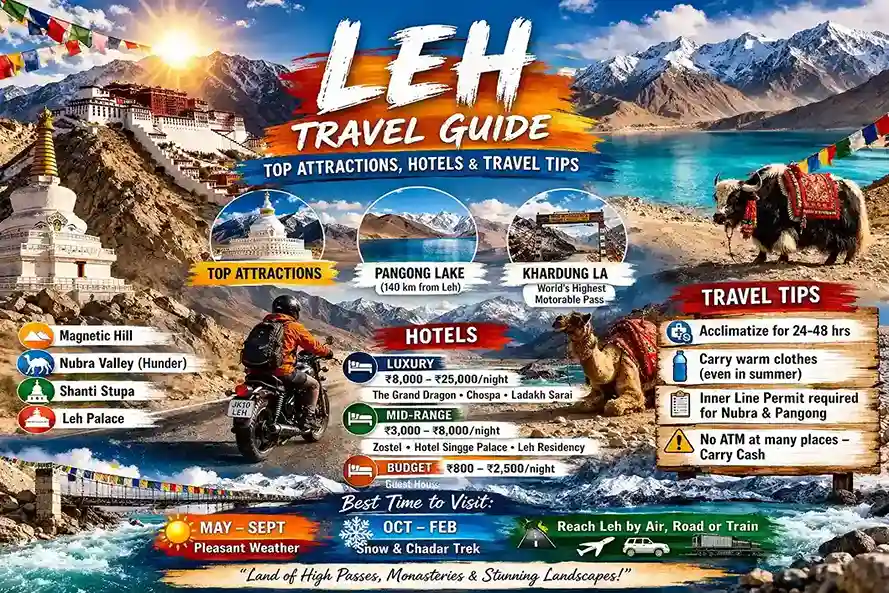
Pangong Lake is the crown jewel of Leh Ladakh tourism. Situated at 4,350 metres altitude, this 134-km-long lake stretches from India into Tibet, with approximately 45 km in India. The lake is famous for its extraordinary colour changes throughout the day — from turquoise to blue to green to silver depending on light and weather. The drive from Leh to Pangong (160 km, 5–6 hrs via Chang La Pass at 5,360m — one of the world’s highest motorable passes) is itself one of the most spectacular road journeys in India. Camping by the lake overnight is an unmissable experience. ILP permit required.
Nubra Valley
Nubra Valley is reached via Khardung La Pass (5,359m) — the world’s highest motorable pass and one of the most famous roads in India. The valley is a surreal landscape of sand dunes, wildflowers, Buddhist monasteries, and the confluence of the Shyok and Nubra rivers. The main attractions include the Diskit Monastery (Ladakh’s oldest and largest monastery, featuring a 32-metre Maitreya Buddha statue), Hunder sand dunes (rare double-humped Bactrian camel rides available), and Panamik hot springs. Distance from Leh: 150 km, approximately 4–5 hours. ILP permit required.
Leh Palace
The Leh Palace is a 17th-century nine-storey royal palace built by King Sengge Namgyal, modelled after Lhasa’s Potala Palace in Tibet. Perched on a hilltop overlooking Leh town at 3,524m, it offers panoramic views of the Stok Kangri range, Zanskar mountains, and the Leh valley. The palace is now an ASI-protected monument and museum showcasing royal costumes, royal seals, weapons, and Buddhist artifacts. Entry: ₹50 for Indians. The best time to visit is early morning for soft light and fewer visitors.
Magnetic Hill
Magnetic Hill is one of Ladakh’s most famous natural curiosities — an optical illusion on the Leh–Kargil highway where vehicles appear to move uphill on their own without engine power. Located at 14,000 ft above sea level, 30 km from Leh, it is a quick and entertaining stop on the Kargil road. Near Magnetic Hill is the confluence of Indus and Zanskar rivers — one of the most photographed spots in Ladakh where the two rivers meet in dramatically different colours.
Hemis Monastery
Hemis Monastery is the largest and wealthiest Buddhist monastery in Ladakh, located 45 km south of Leh at 3,600m. Built in 1630 by the Ladakhi king Sengge Namgyal, it is home to one of India’s most spectacular masked dance festivals — the Hemis Festival (held every June–July, coinciding with the birthday of Guru Padmasambhava). The monastery houses rare thangka paintings, gold and silver statues, and a collection of ancient Buddhist manuscripts. Entry: ₹50 for Indians.
Thiksey Monastery
Thiksey Monastery, 19 km from Leh, is often called “little Lhasa” due to its resemblance to the Potala Palace. The 12-storey complex houses a 15-metre Maitreya Buddha statue — one of the largest in Ladakh — along with prayer halls, ancient wall paintings, and a collection of Buddhist art. The morning prayers (Puja) at 6–7 AM are one of the most atmospheric experiences in Leh Ladakh and are open to visitors. Entry: ₹50.
Shanti Stupa
Shanti Stupa is a white-domed Buddhist peace pagoda on a hilltop 5 km from Leh city centre, at 3,700m. Built in 1991 to promote world peace and commemorate 2,500 years of Buddhism, it offers the best panoramic views of Leh city, the Indus Valley, and the surrounding Himalayan ranges. The stupa is particularly stunning at sunset and sunrise. 496 steps lead to the top — easy for acclimatised visitors, challenging for Day 1 arrivals. Entry: free.
Zanskar Valley
Zanskar Valley is one of Ladakh’s most remote and dramatically beautiful regions, enclosed by the Himalayan and Zanskar mountain ranges. Famous for the Chadar Trek — a winter trek on the frozen Zanskar River that is one of India’s most challenging and rewarding trekking experiences — Zanskar is also increasingly accessible in summer after the completion of new road connections. The valley has several ancient monasteries including Phugtal (accessible only by foot) and Karsha. For experienced trekkers and adventure travelers.
Adventure Activities in Leh Ladakh
- Leh Ladakh Bike Trip: One of India’s most iconic road trips. Rent Royal Enfield or KTM bikes in Leh market (₹800–1,500/day). Popular circuits: Manali–Leh–Srinagar (Grand Circuit), Leh–Nubra–Pangong loop (4–5 days). Riding experience on mountain roads essential. Carry tool kit, spare parts, and first aid.
- River Rafting on Indus: White-water rafting on the Indus River near Phey and Nimmu offers Grade 2–3 rapids suitable for beginners. Duration: 1–3 hours. Cost: ₹600–₹1,000/person. Operated by licensed operators from Leh. Best months: June to September.
- Trekking: Leh Ladakh offers some of India’s finest treks — Markha Valley Trek (5–6 days), Stok Kangri Summit Trek (highest non-technical summit at 6,153m), Chadar Trek (January–February on frozen Zanskar River), and Lamayuru to Alchi Trek. Most require a registered guide.
- Mountain Biking: Leh is the mountain biking capital of India. Trails range from easy valley rides to technical downhill on Khardung La. Gear rental available in Leh market.
- Stargazing: Leh Ladakh at 3,500m+ altitude with zero light pollution offers some of India’s clearest night skies. Hanle (4,500m) is home to the Indian Astronomical Observatory. The Milky Way is visible to the naked eye on clear nights — an extraordinary experience for city travelers.
Hotels in Leh Ladakh — All Budget Options (2026)
Accommodation in Leh Ladakh ranges from luxury hotels to budget guesthouses and eco-camps. The main hotel areas in Leh are: Main Bazaar (most hotels, restaurants, shops), Fort Road (mid-range hotels with views), and Changspa Lane (quiet budget guesthouses and cafes popular with backpackers).
Luxury Hotels in Leh (₹8,000–₹20,000/night)
- The Grand Dragon Ladakh: 5-star property with mountain views, spa, and fine dining. Leh’s premium hotel.
- Hotel The Kaal Leh Ladakh: Luxury boutique hotel with panoramic Himalayan views and all modern amenities.
- Luxury eco-camps at Pangong Lake: Swiss tents with attached bathrooms and stunning lake views. ₹5,000–₹12,000/night.
Mid-Range Hotels in Leh (₹3,000–₹7,000/night)
- Leh Stumpa Hotel: Well-rated mid-range hotel in central Leh with mountain views and good connectivity.
- Sangaylay Palace: Heritage property with traditional Ladakhi architecture, centrally located.
- Guesthouses on Fort Road: Many family-run mid-range guesthouses with rooftop views of Leh Palace. Good breakfast included.
Budget Hotels & Hostels in Leh (₹800–₹2,500/night)
- Changspa Lane Guesthouses: Quiet, clean rooms away from main bazaar noise. Popular with solo travelers and backpackers.
- The Crash Pad Hostel: Well-known backpacker hostel with dorms and privates, social atmosphere.
- LONPO GUEST HOUSE: Budget-friendly option with basic amenities and friendly local hosts.
Booking tip: Book Leh hotels 60–90 days ahead for June–August. Pangong Lake camps especially fill up 3–4 months in advance. For Durga Puja and Independence Day week, book 4–5 months ahead.
Leh Ladakh Trip Budget — Complete 2026 Cost Breakdown
| Expense | Budget | Mid-Range | Luxury |
|---|---|---|---|
| Flights (return) | ₹5,000–₹10,000 | ₹8,000–₹15,000 | ₹15,000–₹30,000 |
| Accommodation (per night) | ₹800–₹2,500 | ₹3,000–₹7,000 | ₹8,000–₹20,000 |
| Food (per day) | ₹400–₹700 | ₹700–₹1,500 | ₹1,500–₹4,000 |
| Transport (cab/bike per day) | ₹500–₹800 (bike) | ₹2,500–₩4,000 (cab) | ₹5,000–₹8,000 (SUV) |
| Permits & entry fees | ₹600–₹800 | ₹800–₹1,000 | ₹1,000+ |
| Total 7-day trip | ₹15,000–₹25,000 | ₹25,000–₹45,000 | ₹60,000+ |
All prices per person. Traveling in a group of 4 reduces per-person transport cost by 40–50%.
Food & Local Experience
- Try local cuisine: momos, thukpa, butter tea
- Local markets offer Pashmina shawls, handicrafts, and Tibetan jewelry
- Family-friendly eateries and small cafes provide authentic Ladakhi food
Leh Ladakh Travel Tips — Essential Guide for 2026
- Rest on arrival day — non-negotiable: No matter how fit you are, your body needs 24 hours to adjust to 11,500 ft. Don’t plan sightseeing on Day 1. This is the single most important rule for Leh Ladakh.
- Only postpaid SIM cards work in Ladakh: Airtel, BSNL, and Jio postpaid SIMs work in Leh and major areas. Prepaid SIMs do NOT work anywhere in Ladakh. Buy or activate a postpaid connection before leaving your home city.
- Carry minimum ₹15,000 cash: ATMs in Leh work but often run out of cash or have network failures. There are NO ATMs in remote areas like Pangong, Nubra, or Zanskar. Carry sufficient cash before leaving Leh city.
- Pack for extreme temperature variation: Days can be 25°C and sunny. Nights drop to 5–10°C even in July. High passes can be below 0°C. Pack: thermal base layer, fleece mid-layer, windproof jacket, sunscreen SPF 50+ (UV is extremely strong at altitude), sunglasses, gloves.
- Book Gondola/Cable car in Gulmarg in advance: If your Leh Ladakh package includes Kashmir, book Gondola tickets at jammukashmircablecar.com before arriving.
- Carry a pulse oximeter: Available for ₹500–800 online. Monitors your blood oxygen levels (SpO2). Reading below 85% means rest. Below 75% means descend and seek help immediately.
- Plastic-free zone: Ladakh has banned single-use plastic since 2016. Do not carry single-use plastic water bottles — carry a reusable insulated flask. Water refill stations are available in major villages.
- Book hotels and packages 3–4 months ahead: Leh Ladakh is India’s fastest-growing adventure tourism destination. June–August accommodation fills up completely. For Independence Day week and Hemis Festival, book 4+ months ahead.
Leh Ladakh Tour Packages from Content Holidays
Ready to plan your Leh Ladakh trip? Here are our most popular packages — all fully customizable, privately operated from Leh, and including airport transfers, private cab, daily meals, and verified accommodation.
Short Trip
Magical Ladakh 6 Days 5 Nights
Leh · Nubra Valley · Pangong Lake · Monasteries
₹18,000 /person
View Package →Most Popular
Leh Ladakh Tour 8 Days 7 Nights
Leh · Nubra · Pangong · Tso Moriri · Monasteries
₹24,000 /person
View Package →Extended
Breathtaking Leh 9 Days 8 Nights
Leh · Nubra · Pangong · Tso Moriri · Zanskar
₹28,000 /person
View Package →Ultimate
Kashmir Ladakh 12 Days 11 Nights
Srinagar · Gulmarg · Pahalgam · Leh · Nubra · Pangong
₹38,000 /person
View Package →Need a custom Leh Ladakh package? Contact our team — we operate all packages directly from Leh.
Why Choose Content Holidays
Planning your Leh trip with Content Holidays ensures:
- Customized travel packages
- Comfortable transportation and verified accommodations
- Local expertise and hassle-free planning
Visit 👉 Content Holidays to plan your dream Leh trip.
Frequently Asked Questions
Q: How many days are enough for Leh Ladakh?
A: A minimum of 7 days is recommended for a first-time visit to Leh Ladakh. This allows 1 day for acclimatisation in Leh, 1 day for local sightseeing (Leh Palace, Shanti Stupa, monasteries), 1–2 days for Nubra Valley, and 1–2 days for Pangong Lake. For a more complete trip including Tso Moriri or Zanskar Valley, 9–12 days is ideal. A 3-day trip to Leh is not recommended — altitude acclimatisation alone takes 1–2 days, leaving very little time for sightseeing.
Q: What is the Leh Ladakh permit cost in 2026?
A: The total permit/environmental fee for visiting Leh Ladakh in 2026 is approximately ₹600–₩800 per person — comprising Green Fee (₹400), Red Cross Fund (₹100), and Wildlife Protection Fee (₹20/day). These fees apply to all tourists including Indians. Additional Inner Line Permits (ILP) are required for Nubra Valley, Pangong Lake, and Tso Moriri — these are issued free alongside the environmental fees at lahdclehpermit.in or at the DC Office in Leh. Foreign tourists also need a Protected Area Permit (PAP) from the DC Office.
Q: Is Leh Ladakh safe for solo female travelers?
A: Yes. Leh Ladakh is considered one of India’s safest destinations for solo female travelers. The local Ladakhi population is peaceful, respectful, and accustomed to international tourists. Leh town is well-lit and active until 10 PM. Standard precautions apply: inform your hotel of your itinerary, avoid solo treks to remote areas, and ensure your driver’s number is saved. Most solo female travelers report feeling extremely safe in Ladakh.
Q: Can I visit Leh Ladakh in winter?
A: Yes, but only for experienced travelers who are prepared for extreme cold. Winter temperatures in Leh drop to -20°C or below. Roads to Nubra Valley and Pangong Lake may be closed. The unique attractions of winter Ladakh include the famous Chadar Trek (trekking on the frozen Zanskar River in January–February), Losar Festival (Ladakhi New Year), and a completely crowd-free experience at all monuments. Access in winter is only by flight from Delhi — all mountain roads are closed from November to April.
Plan Your Leh Ladakh Trip with Content Holidays
Content Holidays operates Leh Ladakh tour packages directly from our base in the region. Our drivers know every pass, our guides have trekked every trail, and our team personally verifies every hotel before recommending it to our guests. When you book a Leh Ladakh travel package with us, you are not dealing with a Delhi or Mumbai agent — you are dealing with people who live and work in this incredible landscape year-round.
Call or WhatsApp to book your Leh Ladakh package
+91 7006684126
Available 10 AM – 7 PM daily · WhatsApp response within 30 minutes
Get a Free Quote →Also explore: All Leh Ladakh Packages · Kashmir Tour Packages · Srinagar Travel Guide
Anzer Ahmad is a Kashmir-based travel expert and founder of Content Holidays, specializing in customized Kashmir and Leh Ladakh tour packages. With years of on-ground experience helping thousands of travelers explore the valleys of Gulmarg, Pahalgam, and Dal Lake, Ahmad brings firsthand knowledge and trusted guidance to every journey