
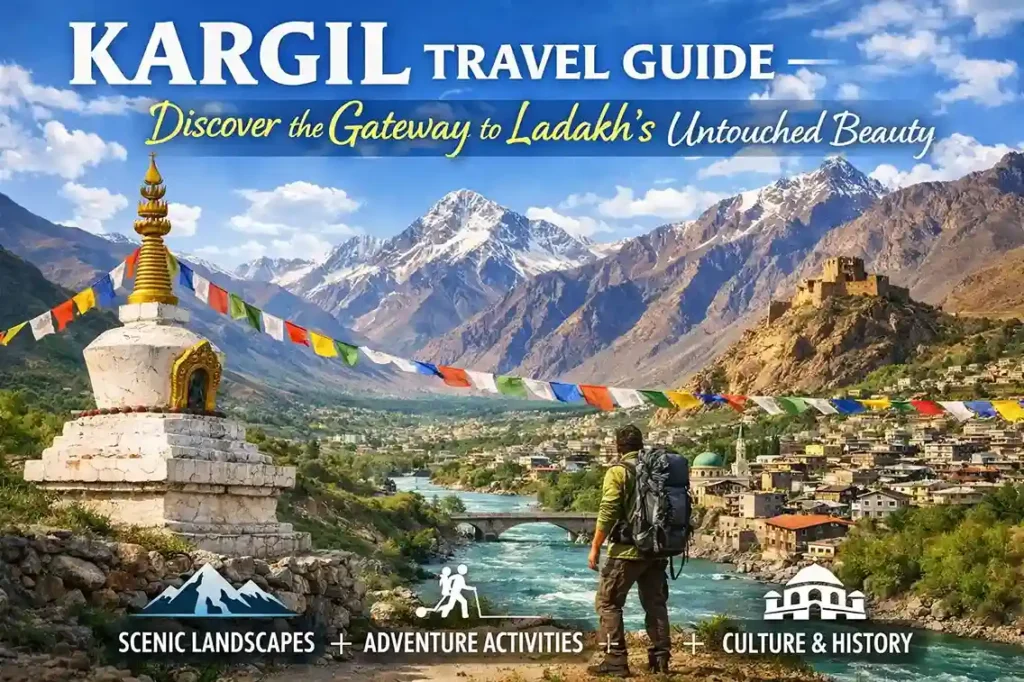
Kargil Travel Guide: Discover the Gateway to Ladakh’s Untouched Beauty
Welcome to the most complete Kargil travel guide for 2026. Situated at 2,704 metres (8,858 feet) above sea level at the confluence of the Drass and Wakha tributaries of the Suru River, Kargil is the second largest urban centre in Ladakh and the gateway connecting Srinagar to Leh on the legendary Srinagar–Leh Highway (NH-1).
Most travelers encounter Kargil as an overnight halt on the Srinagar–Leh drive — approximately 204 km from Srinagar and 234 km from Leh. But Kargil deserves far more than a single night. It is the district headquarters of Kargil district — a vast territory that contains some of Ladakh’s most extraordinary landscapes: the Suru Valley, the Zanskar Valley (accessible only from Kargil), Drass (the second coldest inhabited place on earth), the ancient Buddhist monasteries of Mulbekh and Rangdum, and the Kargil War Memorial — one of the most emotionally powerful sites in India.
Kargil is also one of India’s most culturally unique destinations. Unlike the Buddhist-dominated district of Leh, Kargil is primarily Shia Muslim — its people are descendants of Balti, Dard, and Tibetan communities whose identity blends Central Asian, Persian, and Ladakhi influences. This religious and cultural contrast within a single region — Buddhist monasteries and mosques coexisting in adjacent valleys — gives Kargil a depth that most visitors never expect.
This Kargil travel guide covers everything: the full story of the 1999 Kargil War, all major attractions from Drass to Zanskar, month-by-month best time to visit, how to reach from Srinagar and Leh, hotels, food, and a practical travel plan. As a Srinagar-based travel operator, our team passes through Kargil regularly — everything in this guide comes from firsthand knowledge of the route.
⛰️ Altitude: 2,704 metres (8,858 ft) · Suru River valley
🚗 Distance: 204 km from Srinagar (6–7 hrs) · 234 km from Leh (5–6 hrs)
📅 Best Time: May to September · Road from Srinagar open May–November
🌡️ Temperature: Summer: 8–35°C · Winter: -20°C to -50°C (extreme cold)
🎫 Permit: No permit required for Kargil town · Zanskar Valley needs ILP
✈️ Nearest Airport: Kushok Bakula Rimpochee Airport, Leh (234 km)
🏛️ Famous For: 1999 Kargil War Memorial · Drass · Suru Valley · Zanskar gateway · Mulbekh Monastery
The 1999 Kargil War — History Behind India's Most Famous Battle
Kargil’s name is permanently etched in Indian history because of the 1999 Kargil War — officially called Operation Vijay — one of the most significant military conflicts in post-independence India.
What Happened in the Kargil War?
In the winter of 1998–1999, Pakistani soldiers and militants secretly occupied strategic peaks and positions in the Kargil district — exploiting the Indian Army’s withdrawal to lower positions during winter. When Indian patrols discovered the intrusion in May 1999, it triggered a 2.5-month conflict that lasted from May 3 to July 26, 1999. Pakistani forces had occupied peaks including Tiger Hill (Point 4590), Tololing, and multiple positions overlooking the Srinagar–Leh Highway — giving them a strategic advantage that threatened to cut off Ladakh from the rest of India. Indian Army, Air Force, and paramilitary forces fought to reclaim these positions in some of the highest-altitude combat in military history — at elevations above 15,000–18,000 feet.
Operation Vijay — The Indian Response
The Indian Army launched Operation Vijay to recapture the occupied positions. The Indian Air Force launched Operation Safed Sagar — the first sustained air campaign in the Himalayas. Over 200,000 Indian soldiers were mobilised. The conflict resulted in significant casualties on both sides. India recaptured all positions by July 26, 1999 — now celebrated as Kargil Vijay Diwas (Kargil Victory Day) every year.
Kargil War Vijay Diwas (July 26)
July 26 is celebrated as Kargil Vijay Diwas across India every year — at the War Memorial in Dras, the ceremony is attended by families of martyrs, Army officials, and thousands of citizens. Visiting Kargil around July 26 provides one of the most moving patriotic experiences in India.
Top Places to Visit in Kargil District
1. Kargil War Memorial, Dras — Most Visited Site
The Kargil War Memorial at Dras (60 km from Kargil town) is the most important and emotionally powerful site in Kargil district. Built by the Indian Army to commemorate the 527 soldiers who gave their lives in the 1999 Kargil War, the memorial features:
- A pink sandstone wall engraved with the names of all 527 martyrs — touching this wall while reading the names is an experience that stays with every visitor
- A museum with war artefacts, photographs, weapons, and detailed accounts of the conflict
- Direct view of Tiger Hill — the most famous peak recaptured during the war
- A permanent flame (Vijay Jyoti) burning in memory of the martyrs
Entry: Free. Timings: 9 AM–7 PM. Photography: Allowed in most areas. The memorial is particularly moving on July 26 (Kargil Vijay Diwas) when annual commemorations take place.
2. Drass — Second Coldest Inhabited Place on Earth
Drass (60 km west of Kargil on NH-1 toward Srinagar) holds the extraordinary distinction of being the second coldest inhabited place in the world — only Oymyakon in Siberia is colder. Winter temperatures in Drass regularly reach -45°C to -60°C. In summer (May–September), Drass transforms into a green valley with a pleasant climate, making it the ideal time to visit. Beyond the War Memorial, Drass offers:
- Views of the peaks where the 1999 conflict was fought
- Tambis Waterfall — a spectacular cascade near the town
- Shergol — a tiny village with ancient cave paintings and a Buddhist monastery
- Unique cultural mix of Dard and Shin communities
3. Suru Valley — Kargil's Hidden Paradise
The Suru Valley is one of the most beautiful and least-visited valleys in all of Ladakh — and it begins right at Kargil town. Stretching south from Kargil all the way to Pensi La Pass (4,400m), the Suru Valley is Kargil’s crown jewel. At its heart tower the magnificent Nun (7,135m) and Kun (7,077m) peaks — the highest mountains in Ladakh and among the most challenging mountaineering objectives in India. The valley is spectacularly green in summer — orchards of mulberry, apple, and apricot, fields of wheat and barley, and rushing glacial streams make it a complete contrast to the arid Leh district. The Suru Valley is a destination in its own right for trekking, mountaineering, and photography.
4. Mulbekh Monastery & Chamba Rock Sculpture
Mulbekh (45 km east of Kargil on NH-1 toward Leh) is famous for its extraordinary 9-metre rock-carved statue of Maitreya Buddha (Chamba) — carved directly into a sheer cliff face in the 7th–8th century. This is one of the oldest Buddhist rock carvings in India and is designated as a National Heritage Monument. The Mulbekh Monastery sits above the carving and offers panoramic valley views. A must-stop for anyone driving the Srinagar–Leh highway.
5. Lamayuru — Moonland of Ladakh
Lamayuru (125 km east of Kargil, on the approach to Leh) is one of the most surreal landscapes in Ladakh — a village perched above a moonlike landscape of dramatically eroded mountains that resemble the surface of the moon. Lamayuru is also home to one of Ladakh’s oldest and largest monasteries (estimated 10th–11th century) with stunning views of the Indus Valley. The “Moonland” landscape on the approach to Lamayuru is one of the most photographed sights on the entire Srinagar–Leh highway.
6. Rangdum Monastery
Rangdum Monastery (Rangdum Gompa) sits at 4,031m in a dramatic valley en route to Zanskar — one of the most photographed monasteries in all of Ladakh, famous for its isolated setting against a backdrop of glaciers and mountains. The 18th-century monastery is home to 40 monks and belongs to the Gelugpa sect. The drive from Kargil to Rangdum (140 km via Suru Valley) is itself one of the most scenic in the entire Himalayan region.
7. Hunderman Village — Village Visible from Pakistan
Hunderman is a remote village near the Line of Control (LoC) with Pakistan — so close that Pakistani villages are clearly visible from its hilltops. The village was once divided by the LoC, with some families ending up on the Pakistani side. The Unlock Hunderman — Museum of Memories here is a moving exhibition of the village’s divided history. Less visited than the War Memorial but equally powerful as a border experience.
8. Zanskar Valley — Gateway from Kargil
Kargil is the only road gateway to the remote Zanskar Valley — one of the world’s most isolated inhabited regions. The route from Kargil to Padum (the Zanskar capital) covers 230 km via the Suru Valley, crossing Pensi La Pass (4,400m). Zanskar is famous for the legendary Chadar Trek (trekking on the frozen Zanskar River in January–February), its ancient monasteries (Karsha, Phugtal), and its extraordinary isolation. For travelers willing to extend their Kargil itinerary, Zanskar adds one of India’s greatest adventure experiences.
9. Domkhar Rock Art Sanctuary
The Domkhar Rock Art Sanctuary contains one of the finest collections of prehistoric rock carvings in the Himalayan region — including carvings of animals, hunting scenes, and geometric patterns estimated to be 5,000+ years old. Located 60 km from Kargil town on the banks of the Suru River. A fascinating stop for history enthusiasts.
Top Things to Do in Kargil
White Water Rafting on Suru River
The Suru River offers excellent white-water rafting opportunities — Grade 3–4 rapids through deep Himalayan gorges. The rafting season runs from June to September when glacial melt swells the river. Multiple operators in Kargil town offer rafting packages (₹1,500–₩3,000/person for a half-day session). One of the most underrated adventure activities in Ladakh.
Trekking — Zanskar, Suru Valley & Nun-Kun Base Camp
Kargil district offers some of Ladakh’s most rewarding and least-crowded trekking routes:
- Nun-Kun Base Camp Trek: 7–10 days through Suru Valley to the base of Nun (7,135m) and Kun (7,077m) — Ladakh’s highest peaks. For experienced trekkers.
- Padum–Lamayuru Trek: Multi-day traverse from Zanskar to Leh via ancient mountain trails. One of Ladakh’s classic treks.
- Sankaru–Dras Trek: 5–6 day route through dramatic high passes. Less-known and spectacular.
Kargil War Memorial Visit + Tiger Hill View
Standing at the Kargil War Memorial and looking up at Tiger Hill — where Indian soldiers fought at -20°C to reclaim the peak — is one of the most patriotically moving experiences in India. The army museum next to the memorial provides a comprehensive account of the conflict with actual weapons, photographs, and soldier stories.
Apo Market Exploration
Kargil’s Apo Market is the district’s main bazaar — a vibrant, authentic market where local artisans sell traditional crafts including handmade Tibetan flutes, copper eating bowls, Ladakhi embroidered shoes, saffron, dried apricots, and walnuts. The market is best visited in the morning and is one of those rare Indian markets where tourism has not yet homogenised the produce — you are buying from local craftspeople.
Monastery Circuit — Mulbekh to Lamayuru
The stretch of road between Kargil and Leh passes through some of the oldest Buddhist monasteries in Ladakh — Mulbekh (9m Maitreya carving), Rizong Monastery, Likir, and ultimately Lamayuru. Combining this monastery circuit with the Srinagar–Leh highway drive creates one of the richest cultural road journeys in India.
Kargil Vijay Diwas (July 26)
If your travel dates allow, planning a visit to Kargil around July 26 (Kargil Vijay Diwas) gives you access to the annual commemoration ceremony at the Dras War Memorial — attended by army officials, martyrs’ families, and thousands of visitors. It is one of India’s most emotionally powerful public events and a deeply meaningful way to understand Kargil’s significance.
Where is Kargil Located
Kargil is situated in the western part of Ladakh, between Srinagar and Leh. It lies in the Zanskar range of the Himalayas and is close to the Line of Control (LoC) between India and Pakistan.
The town sits at an altitude of around 2,676 meters, making it more accessible compared to higher regions of Ladakh.
How to Reach Kargil — Distance & Travel Options
By Road from Srinagar (Most Common Route)
The Srinagar to Kargil distance is approximately 204 km on the Srinagar–Leh Highway (NH-1). Journey time: 6–7 hours. The route passes through Sonamarg (85 km), Zoji La Pass (3,528m — the main pass on this route), and Drass before reaching Kargil. NH-1 is open from approximately May to November — closed in winter when Zoji La is blocked by snow.
This is the most popular route as Srinagar has better flight connectivity and the Srinagar–Kargil road is scenic and historically significant.
By Road from Leh (Return Route)
The Leh to Kargil distance is approximately 234 km on NH-1. Journey time: 5–6 hours. The route passes through Lamayuru (Moonland), Mulbekh (Chamba rock carving), and Shergol. Kargil is commonly used as an overnight halt for travelers doing the full Srinagar–Leh highway journey.
Distance Table
| From | Distance | Journey Time |
|---|---|---|
| Srinagar to Kargil | 204 km | 6–7 hours via Sonamarg + Zoji La |
| Leh to Kargil | 234 km | 5–6 hours via Lamayuru + Mulbekh |
| Kargil to Drass (War Memorial) | 60 km | 1.5 hours |
| Kargil to Mulbekh | 45 km | 1 hour |
| Kargil to Padum (Zanskar) | 230 km | 8–10 hours via Suru Valley + Pensi La |
By Air (Nearest Airport)
Kargil has no airport. The nearest airport is Kushok Bakula Rimpochee Airport in Leh (234 km), which has daily flights from Delhi, Srinagar, Mumbai, Chandigarh, and Jammu. From Leh, hire a private taxi to Kargil (5–6 hours, ₹3,000–₩5,000/vehicle).
By Train (Nearest Railway Station)
The nearest major railway station is Jammu Tawi (540 km). From Jammu, travel to Srinagar by road (7–8 hours) then Srinagar to Kargil (6–7 hours). Total from Jammu: approximately 14–16 hours.
By Bus
J&K SRTC operates buses on the Srinagar–Kargil and Leh–Kargil routes. Budget option but schedules are limited and journey times are longer. Private cabs are recommended for better flexibility.
Best Time to Visit Kargil — Month by Month Guide
Kargil’s climate is extreme — scorching summers and life-threatening winters. Planning your visit in the right months is essential.
| Month | Temperature | Road Status | Experience |
|---|---|---|---|
| Mar–Apr | 5°C – 20°C | NH-1 opening (late Mar/Apr) | Srinagar-Kargil road opens. Apricot blossom in orchards. Few crowds. Scenic. |
| May–June | 10°C – 30°C | Open ✅ | ✅ Pleasant weather. All routes open. Suru Valley green. Good for trekking start. |
| July | 15°C – 35°C | Open ✅ Peak season | Kargil Vijay Diwas (July 26). Peak tourist season. Rafting at best. Some landslide risk. |
| August | 15°C – 32°C | Open ✅ | Good weather. Apricot harvest. Some monsoon-related landslides possible on NH-1. |
| September | 8°C – 25°C | Open ✅ Best month | Best overall. Clear skies, comfortable temperatures, fewer crowds, walnut harvest. |
| October | 0°C – 15°C | Closing — check daily | NH-1 closing season. Autumn colours. Cold nights. Not recommended for first-timers. |
| Nov–Feb | -20°C – -50°C | NH-1 closed | Extreme cold. Roads blocked. Life-threatening conditions. Avoid completely. |
Food & Local Culture in Kargil
Kargil’s cuisine is a fascinating blend of Ladakhi Buddhist, Balti Muslim, and Central Asian influences — reflecting its position at the crossroads of multiple cultural worlds. The town is predominantly Shia Muslim, giving its food culture a distinct character from the Buddhist-dominated Leh district.
Must-Try Dishes in Kargil
- Thukpa: Hearty noodle soup with vegetables or meat — the standard Ladakhi comfort meal, available at almost every restaurant in Kargil.
- Momos: Steamed or fried dumplings with vegetable or meat filling. Fresh and simple — the perfect mountain snack.
- Skyu: Traditional Ladakhi pasta dish — thumb-shaped pieces of dough cooked in a thick vegetable stew. Unique to this region.
- Tsampa: Roasted barley flour mixed with butter tea or water — the traditional Ladakhi staple that has sustained mountain communities for centuries.
- Apricot-based dishes and desserts: Kargil district orchards produce extraordinary apricots. Apricot jam, dried apricots, and apricot oil are local specialties.
- Butter tea (Po Cha): Salty, buttery tea brewed with black tea leaves. An acquired taste but deeply warming at altitude.
Cultural Identity
What makes Kargil culturally unique is its multi-layered identity. Most of Ladakh is Tibetan Buddhist — its monasteries, prayer flags, and stupas define the landscape. Kargil is different: its residents are primarily Shia Muslim with a heritage rooted in Balti, Dard, and Shin communities. Yet the region also has ancient Buddhist monasteries (Mulbekh, Rangdum) coexisting with mosques — a rare example of religious coexistence shaped by geography and history rather than political design.
Kargil Hotels & Stay Options
Kargil town has a good range of accommodation for its size — from budget guesthouses to mid-range hotels. There are no 5-star hotels but the 3–4 star options offer comfortable rooms with mountain views.
Hotels in Kargil Town
- Hotel D’Zojila (Mid-Range): One of Kargil’s most popular hotels — clean rooms, good food, mountain views, reliable hot water. ₹2,500–₹5,000/night.
- Hotel Zojila Residency: Well-located in central Kargil with comfortable rooms and a multi-cuisine restaurant. ₹2,000–₀4,000/night.
- Budget guesthouses: Multiple family-run guesthouses in Kargil main market area offering clean, basic rooms with meals. ₹500–₩1,500/night.
- JKTDC Tourist Bungalow: Government accommodation — basic, reliable, and good value. Book in advance during peak season.
Homestays near Drass & Suru Valley
For travelers wanting to explore the Drass area or Suru Valley in depth, local homestays offer the most authentic experience — sharing meals with a Ladakhi or Balti family and hearing firsthand accounts of life near the Line of Control. Ask your tour operator or the JKTDC office in Kargil for current homestay options.
Booking tip: Kargil fills up quickly during July (Vijay Diwas period) and August. Book at least 4–6 weeks ahead for these months. For other months, 1–2 weeks ahead is usually sufficient.
Kargil Trip Cost — 2026 Budget Breakdown
| Expense | Budget | Mid-Range | Notes |
|---|---|---|---|
| Transport Srinagar–Kargil (private taxi) | ₹800–₹1,200/person | ₹3,500–₹5,000/vehicle | Private more flexible |
| Hotel (per night) | ₹500–₹1,500 | ₹2,000–₀5,000 | No 5-star options |
| Food (per day) | ₹300–₩600 | ₹600–₩1,200 | Good local options |
| Sightseeing taxi (local) | ₹500–₩800/person | ₹2,000–₩4,000/vehicle | Drass + War Memorial day trip |
| Entry fees (memorials, monasteries) | ₹50–₩200/site | Same | War Memorial is free |
| Total 2-night Kargil trip | ₹2,500–₩4,500/person | ₹5,000–₩10,000/person | Group of 2–4 persons |
Kargil Travel Tips & Essentials
- Carry valid government ID always: Kargil is a military-sensitive border area. Police and army checkpoints are regular — Aadhaar card, Voter ID, or Passport required. Keep photocopies in a separate bag from originals.
- Acclimatise in Srinagar before arriving at Kargil: At 2,704m, Kargil is significantly higher than Srinagar (1,585m). If coming directly from lower altitudes, allow 1 night in Kargil before proceeding to higher areas.
- NH-1 landslides — check road status: The Srinagar–Kargil highway passes through landslide-prone zones. During July–August, check current road status before departing. Carry extra food and water in case of delays.
- Carry cash: ATMs exist in Kargil town but may have connectivity issues. Cash is essential for smaller establishments, monasteries, and rural areas.
- Diamox and basic medicines: Carry a basic medical kit. Altitude sickness medication (Diamox) is useful for those proceeding to Leh or Zanskar. The nearest hospital with full facilities is in Leh or Srinagar.
- Dress modestly in Kargil town: Kargil is a conservative Shia Muslim town. Women should dress modestly (covering shoulders and knees) when visiting the main market and mosque areas. This is culturally respectful and appreciated by locals.
- No photography at military checkpoints: Kargil district is a sensitive border area. Strictly no photography of military personnel, installations, or the Line of Control. Follow all army instructions without question.
- ILP required for Zanskar: If proceeding from Kargil into Zanskar Valley, an Inner Line Permit is required. Apply at DC Office Kargil or online at lahdclehpermit.in before departing.
- Best petrol stop: Fill tank in Kargil town before heading toward Zanskar or Drass — petrol pumps are sparse in rural Kargil district.
Visit Kargil with Content Holidays — Kashmir & Ladakh Packages
Kargil sits on the Srinagar–Leh Highway — the same road that our Content Holidays team travels regularly. As a Srinagar-based operator 204 km from Kargil, we know this route personally. Our Srinagar–Leh packages include Kargil as an overnight halt, with visits to the War Memorial and monasteries planned into the itinerary.
Via Kargil Route
Kashmir 7 Days 6 Nights Package
Srinagar · Sonamarg · Kargil · Leh · Nubra · Pangong
₹24,000 /person
View Package →Srinagar to Leh
Kashmir + Ladakh 12 Days 11 Nights
Srinagar · Gulmarg · Pahalgam · Kargil · Leh · Nubra · Pangong
₹38,000 /person
View Package →Kashmir Only
Kashmir 5 Days 4 Nights Package
Srinagar · Gulmarg · Pahalgam · Sonamarg · Houseboat
₹16,000 /person
View Package →Custom
Custom Srinagar–Kargil–Leh Package
Any duration · Kargil War Memorial included · Suru Valley option
From ₹15,000 /person
Get Custom Quote →Plan your Kargil visit with Content Holidays
+91 7006684126
Srinagar-based operator · Kargil War Memorial visits planned · Suru Valley + Zanskar expertise
Get a Free Quote →Also see: Leh Ladakh Travel Guide · Kashmir Tour Packages · Nubra Valley Travel Guide
Frequently Asked Questions
Q: What is Kargil famous for?
A (EXPANDED): Kargil is famous for three things: (1) The 1999 Kargil War (Operation Vijay) — the conflict between India and Pakistan that is commemorated at the Kargil War Memorial in Dras, (2) Being the “Gateway to Ladakh” on the Srinagar–Leh Highway — the most scenic road in India, and (3) The Suru Valley — one of Ladakh’s most beautiful landscapes with the towering Nun-Kun massif and the route to the remote Zanskar Valley.
Q: How far is Kargil from Leh?
A (EXPANDED): Kargil is approximately 234 km from Leh on the Srinagar–Leh Highway (NH-1). The journey takes 5–6 hours by private taxi. The route passes through Lamayuru village (famous for Moonland landscape), the 9th-century Mulbekh Chamba rock carving, and the dramatic Zoji La Pass approach. This road is open from approximately March/April to November.
Q: What is the best time to visit Kargil?
A (EXPANDED): May to September is the best time to visit Kargil. The Srinagar–Leh Highway (NH-1) is open and weather is pleasant. July is particularly special — Kargil Vijay Diwas (July 26) commemorates the 1999 war victory with a moving ceremony at the Dras War Memorial. September is the best month for pleasant weather, clear skies, and fewer tourists. Avoid October to April — winter temperatures in Kargil and surrounding areas drop to -20°C to -50°C.
Q: Is Kargil safe for tourists in 2026?
A: Yes — Kargil is safe for tourists in 2026. The 1999 Kargil War is part of history. The town is a busy district headquarters with hotels, restaurants, markets, and regular army presence that ensures security. The main practical considerations are: checking NH-1 road status (landslides possible July–August), dressing modestly in the conservative Muslim town, and not photographing military installations. Millions of travelers pass through Kargil annually on the Srinagar–Leh route without any issues.
Q: What happened in the 1999 Kargil War?
A: The 1999 Kargil War (Operation Vijay) was a conflict between India and Pakistan from May 3 to July 26, 1999. Pakistani soldiers and militants secretly occupied strategic peaks in the Kargil district during winter, threatening to cut off Ladakh from the rest of India. The Indian Army and Air Force launched a major operation to recapture these positions. After 2.5 months of high-altitude combat, India recaptured all positions by July 26, 1999. 527 Indian soldiers died in the conflict — their names are engraved at the Kargil War Memorial in Dras. July 26 is now celebrated as Kargil Vijay Diwas (Victory Day) every year.
Q: What is Drass known for?
A: Drass (60 km from Kargil on NH-1) is known for being the second coldest inhabited place in the world — winter temperatures regularly reach -45°C to -60°C. It is also home to the Kargil War Memorial, which was built to commemorate the 527 soldiers who died in the 1999 Kargil War. The memorial includes a museum, the pink sandstone wall engraved with martyrs’ names, and a direct view of Tiger Hill — the most famous peak recaptured during the war.
Q: Is Kargil on the way from Srinagar to Leh?
A: Yes — Kargil is the main town on the Srinagar–Leh Highway (NH-1). It is located 204 km from Srinagar and 234 km from Leh, making it the natural overnight halt for travelers doing the complete Srinagar–Leh journey. The highway passes through Sonamarg (85 km from Srinagar), Zoji La Pass, Drass, Kargil, Lamayuru, and Mulbekh before reaching Leh. Most travelers doing the full road journey stay at least one night in Kargil.
Anzer Ahmad is a Kashmir-based travel expert and founder of Content Holidays, specializing in customized Kashmir and Leh Ladakh tour packages. With years of on-ground experience helping thousands of travelers explore the valleys of Gulmarg, Pahalgam, and Dal Lake, Ahmad brings firsthand knowledge and trusted guidance to every journey