
Tso Moriri Lake Travel Guide 2026 – Altitude, How to Reach, Permit & Best Time
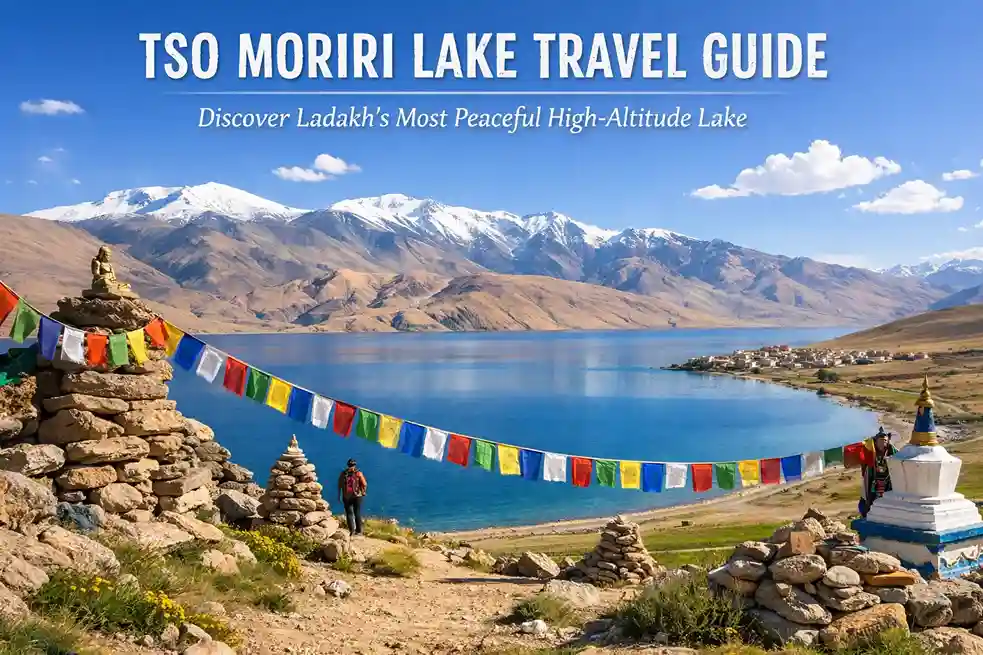
Welcome to the most complete Tso Moriri Lake travel guide for 2026. Tucked away in the remote Changthang plateau of eastern Ladakh — approximately 220 km from Leh and far beyond the tourist trails — Tso Moriri (meaning “Mountain Lake” in the Changthang dialect) is India’s largest high-altitude lake lying entirely within Indian territory, and the world’s highest designated Ramsar Wetland site.
At an altitude of 4,522 metres (14,836 feet) — significantly higher than Pangong Lake at 4,350m — Tso Moriri is a destination that demands preparation, rewards patience, and delivers an experience of extraordinary depth. The lake stretches approximately 26 km in length and 5 km in width, surrounded by peaks rising above 6,000 metres, with no road noise, no commercial infrastructure, and an atmosphere of complete Himalayan silence that is increasingly rare anywhere in India.
What makes Tso Moriri fundamentally different from Pangong Lake is not just its altitude — it is the wildlife. Tso Moriri is one of the world’s few breeding grounds for the critically endangered Black-necked Crane, the only crane species that breeds and winters above 3,000m. The lake also hosts Bar-headed Geese, Brahminy Ducks, Kiang (Tibetan Wild Ass), Blue Sheep, Marmots, and the elusive Snow Leopard. Visiting Tso Moriri is as much a wildlife experience as it is a landscape one.
This Tso Moriri Lake travel guide covers everything: the correct altitude, all 3 routes from Leh, the 2026 ILP permit guide, month-by-month best time, the critical acclimatisation guide (at 4,522m — do not skip this), wildlife and birdwatching, Korzok village and monastery, camping rules, accommodation, budget, and a day itinerary. As a Srinagar-based operator, Content Holidays has taken guests to Tso Moriri on our extended Leh Ladakh packages — this guide reflects firsthand experience of every stop on the route.
⛰️ Altitude: 4,522m (14,836 ft) — higher than Pangong Lake (4,350m)
📏 Size: ~26 km long · ~5 km wide · Largest high-altitude lake entirely in India
🌿 Status: World’s highest Ramsar Wetland site · Tsomoriri Wetland Conservation Reserve
🚗 Distance from Leh: ~220 km · 7–9 hours via Chumathang route
📅 Best Time: May to September · June–September for wildlife and birds
🌡️ Temperature: Summer: 5–20°C days, near 0°C nights · Winter: -25°C to -40°C
🎫 Permit: ILP mandatory (Indians) · PAP mandatory (foreigners) · lahdclehpermit.in
📵 Mobile Network: None at Tso Moriri · Last network at Chumathang (70 km away)
⛺ Camping: NOT permitted at lakeside · Only in Korzok village area
Tso Moriri vs Pangong Lake — Which is Better?
Both Tso Moriri and Pangong are iconic Ladakh lakes — but they offer very different experiences. Here is an honest comparison to help you decide:
| Factor | Tso Moriri | Pangong Lake |
|---|---|---|
| Altitude | 4,522m (14,836 ft) — higher | 4,350m (14,270 ft) |
| Distance from Leh | ~220 km, 7–9 hours | ~160 km, 5–6 hours |
| Crowds | Very few — offbeat, peaceful | Very crowded in peak season |
| Wildlife | Extraordinary — Black-necked Crane breeding, Kiang, Snow Leopard | Limited wildlife near lake |
| Ramsar Status | ✅ World’s highest Ramsar site | Not a Ramsar site |
| Infrastructure | Minimal — basic homestays only | Well-developed — multiple camps |
| Mobile Network | None at lake — last signal at Chumathang (70 km) | Limited but some network at Spangmik |
| Best for | Wildlife, birds, silence, photographers, offbeat travelers | Iconic lake, colour change, camping comfort, first-timers |
Our recommendation: If possible, visit both as part of the Pangong–Chushul–Tso Moriri circuit (3–4 days). If choosing one — first-timers → Pangong. Wildlife/photography lovers and experienced Ladakh travelers → Tso Moriri every time.
Tso Moriri — World's Highest Ramsar Wetland & Wildlife Guide
Tso Moriri is designated as the Tsomoriri Wetland Conservation Reserve under the Ramsar Convention on Wetlands — making it the world’s highest Ramsar site at 4,522m. This international recognition means the lake and surrounding ecosystem are protected for their extraordinary biodiversity. It also means there are strict rules that visitors must follow — including no camping at the lakeside and no disturbance to breeding birds.
Birds of Tso Moriri — 34 Species Including Rare Breeders
Tso Moriri is a birding paradise — one of the world’s great high-altitude birdwatching destinations. The lake hosts 34 species of birds including 14 species of waterbirds. Key species:
- Black-necked Crane (Grus nigricollis): The rarest and most sought-after species at Tso Moriri. Tso Moriri is one of the only places in India where the Black-necked Crane breeds — this critically endangered crane arrives in April–May and departs in September–October. Seeing a pair with chicks by the lakeshore is one of India’s most extraordinary wildlife moments. Best viewing: May to September.
- Bar-headed Goose: One of the world’s highest-flying birds — migrates over the Himalayas. Large flocks visible on and around the lake.
- Brahminy Duck (Ruddy Shelduck): Pairs easily seen along the lakeshore throughout the season.
- Great Crested Grebe: Elegant diving bird with distinctive head plumage. Best seen in morning light.
- Brown-headed Gull: Large flocks visible in July–August.
Mammals of Tso Moriri
- Kiang (Tibetan Wild Ass): The most commonly seen large mammal at Tso Moriri — herds of this beautiful wild ass are frequently spotted on the plains around the lake. Completely unafraid of vehicles, allowing close viewing.
- Himalayan Marmot: Fat, friendly burrowing rodents visible near the lakeshore and surrounding grasslands. Will stand upright and whistle alarm calls if you approach too quickly.
- Blue Sheep (Bharal): Herds visible on the rocky slopes above the lake — especially in morning and evening.
- Snow Leopard: The Changthang plateau is snow leopard habitat. Sightings are rare but possible — especially in winter when prey animals move to lower altitudes. Best chance: early morning on rocky ridges.
- Tibetan Wolf: Occasionally spotted in the plateau grasslands, usually at dawn or dusk.
Birdwatching tips: Bring binoculars (10×42 minimum). Best birdwatching: 6–9 AM and 4–7 PM. June to August for breeding Black-necked Cranes. September for migratory species. The western shore of the lake near Korzok village is the most productive area.
How to Reach Tso Moriri Lake — All 3 Routes from Leh
There are three routes from Leh to Tso Moriri — varying in distance, road quality, and difficulty. All require an ILP permit. The standard route via Chumathang is recommended for first-time visitors.
Route 1 — Leh to Tso Moriri via Chumathang (Standard, Recommended)
Distance: ~220 km · Time: 7–9 hours · Road: Mostly paved
Route: Leh → Upshi → Keru → Chumathang → Mahe → Sumdo → Karzok (Tso Moriri)
- Leh (0 km): Depart by 6–7 AM. Fill fuel completely at Karu (35 km) — last reliable petrol pump before Tso Moriri.
- Upshi (70 km): Checkpoint. Permit verified here. Small tea shops available.
- Chumathang (130 km): Hot springs village. Last point with mobile network (BSNL postpaid, intermittently). Basic food available. Natural hot springs worth a 30-minute stop.
- Mahe (160 km): Checkpoint. Army presence. Permit checked again.
- Sumdo (190 km): Junction — checkpoint. Permit must be presented.
- Karzok / Tso Moriri (220 km): Arrive at the lake. Korzok village on western shore has accommodation.
Route 2 — Leh to Tso Moriri via Tanglang La + Tso Kar (Scenic Route)
Distance: ~240 km · Time: 8–10 hours · Road: Mix of paved and rough sections
Route: Leh → Upshi → Rumtse → Tanglang La (5,325m) → More Plains → Tso Kar → Sumdo → Karzok
This route crosses Tanglang La Pass at 5,325m — one of the world’s highest motorable passes — and passes through the beautiful Tso Kar salt lake, making it a spectacular alternative. Recommended for experienced travelers and bikers.
Route 3 — Pangong Lake to Tso Moriri via Chushul (Adventure Circuit)
Distance: ~240 km from Pangong · Time: 8–10 hours · Road: Remote, rough, partially off-road
Route: Spangmik (Pangong) → Man → Merak → Chushul → Tsaga La → Nyoma → Mahe → Sumdo → Karzok
The ultimate Ladakh circuit — combines Pangong and Tso Moriri in one continuous journey. Extremely remote. Some sections have no proper road (track marks only). Foreign nationals cannot take this route. Indian nationals only, with additional permits from Chushul. High clearance 4×4 essential.
Route Comparison Table
| Route | Distance | Time | Difficulty | Best For |
|---|---|---|---|---|
| Via Chumathang | ~220 km | 7–9 hrs | Moderate ✅ | First-time visitors, all vehicles |
| Via Tanglang La + Tso Kar | ~240 km | 8–10 hrs | Moderate–Hard | Bikers, experienced travelers |
| Via Pangong + Chushul | ~240 km+ | 8–10 hrs | Very Hard | Indians only, 4×4, adventure seekers |
Tso Moriri Lake Permit — Complete 2026 Guide
A permit is mandatory for all visitors — Indian and foreign — to visit Tso Moriri Lake. The lake sits near the Indo-China border (Line of Actual Control). You will be checked at multiple army checkpoints on every route: Upshi, Mahe, and Sumdo. Carry 3–4 photocopies of your permit as each checkpoint keeps one.
For Indian Tourists — ILP + EDF
- How to get: Apply online at lahdclehpermit.in — instant QR code, no printing needed. Or DC Office, Leh (Main Market, 9 AM–3 PM).
- Fee: Environmental Development Fee ₹400 + ILP fee ₹20/day per person
- Document needed: Aadhaar card or any government photo ID
- Validity: Up to 7 days — covers Tso Moriri, Pangong, and Nubra in one permit
For Foreign Tourists — Protected Area Permit (PAP)
- Apply at DC Office Leh or through a registered travel agent
- Must travel in minimum group of 2 persons
- Passport + valid Indian visa required
- Note: The Pangong–Chushul–Tso Moriri circuit (Route 3) is NOT available to foreign nationals
Tso Moriri Altitude & Acclimatisation
At 4,522 metres (14,836 feet), Tso Moriri is one of the highest overnight destinations in all of India. You will be sleeping at this altitude — not just visiting briefly like at a mountain pass. Acute Mountain Sickness (AMS) risk at Tso Moriri is higher than at Pangong Lake or Khardung La. Do not take this lightly.
Minimum Acclimatisation Required Before Visiting
- Mandatory: 2 nights in Leh (3,505m) before going to Tso Moriri
- Recommended: 1 additional night in Nubra Valley or along the route — giving your body a staged altitude gain rather than jumping from Leh directly to 4,522m
- Do not fly from sea level to Leh and drive to Tso Moriri on the same day under any circumstances — this is medically dangerous
AMS Symptoms at Tso Moriri Altitude
- Mild (common): Headache, mild nausea, fatigue — rest, drink water, take paracetamol. Do not ascend further.
- Moderate (descend immediately): Severe headache, vomiting, breathlessness at rest. Descend toward Chumathang (lower altitude).
- Severe (medical emergency): Confusion, inability to walk straight, fluid in lungs. Nearest medical help at Chumathang army post or Leh hospital.
Essential Preparations
- Diamox (Acetazolamide): Consult your doctor before the trip. 125–250mg twice daily starting 1 day before arrival at altitude.
- Pulse oximeter: Carry one (₹500–800). SpO2 below 80% = rest immediately. Below 70% = evacuate.
- Drink 4 litres of water per day: Dehydration worsens AMS dramatically at altitude.
- Warm sleeping gear: Night temperatures at Korzok drop to near 0°C even in July. A -5°C rated sleeping bag is minimum.
- No alcohol for first 48 hours: Alcohol reduces blood oxygen efficiency.
Best Time to Visit Tso Moriri Lake — Month by Month
| Month | Temperature | Lake Condition | Experience |
|---|---|---|---|
| Jan–Apr | -25°C to -40°C | Completely frozen | Extreme cold. Road may be blocked. Dangerous for most travelers. Snow Leopard sighting possible. |
| May | 2°C – 15°C | Thawing, vivid blue | Black-necked Cranes arrive. Few tourists. Fresh, beautiful. Roads just opening. |
| June–July | 5°C – 20°C | Deep blue, full | ✅ Peak season. Black-necked Crane breeding. All wildlife active. Kiang herds on plains. |
| August | 5°C – 20°C | Deep blue | Good wildlife. Peak season. Slightly more tourists than June. |
| September | 0°C – 15°C | Crystal clear | ✅ Best month. Fewest crowds, clearest skies, Black-necked Cranes preparing migration. Extraordinary photography. |
| Oct–Dec | -5°C – -25°C | Freezing / frozen | Cranes departing. Temperature dropping rapidly. Not recommended for most. |
Top Places to Visit Near Tso Moriri Lake
1. Korzok Village & Korzok Monastery
Korzok village on the western shore of Tso Moriri Lake is one of India’s highest inhabited villages at approximately 4,500m. Home to the Changpa nomadic community who herd Pashmina goats across the Changthang plateau, Korzok offers a rare glimpse into a way of life that has barely changed in centuries. The Korzok Monastery (Korzok Gompa) — approximately 400 years old and belonging to the Drupka lineage of Tibetan Buddhism — sits on a small hillock above the village with panoramic views of the lake and surrounding peaks. The monastery is home to several monks and attracts Buddhist pilgrims from across Ladakh. The views of the lake from the monastery walls at sunrise are extraordinary. Entry: donation appreciated. Timings: flexible — ask in the village.
2. Tso Kar Lake — The Twin Lake Circuit
Tso Kar is a high-altitude salt lake approximately 80 km northeast of Tso Moriri — the two are commonly visited together as the “Tso Kar – Tso Moriri Twin Lake Circuit”. Tso Kar sits at 4,530m (even slightly higher than Tso Moriri) and is a striking white salt lake — its shores encrusted with salt deposits that give the surrounding landscape a lunar quality unlike anything else in Ladakh. The lake is also home to Blacknecked Cranes and Bar-headed Geese. Combining both lakes adds 1–2 days to the Tso Moriri itinerary but is widely considered one of Ladakh’s most rewarding experiences.
3. Chumathang Hot Springs
Chumathang — 70 km from Tso Moriri on the standard Leh–Tso Moriri route — is home to natural sulphur hot springs believed to have curative properties. A brief stop here (30–45 minutes) to soak tired feet in the warm springs is a highlight of the Chumathang route journey. Chumathang is also the last point with any mobile connectivity before Tso Moriri.
4. Puga Valley — Geothermal Wonders
Puga Valley near Tso Moriri contains one of India’s most extraordinary geological features — fumaroles (steam vents), boiling mud pits, and natural hot springs fed by geothermal activity beneath the Changthang plateau. The bubbling sulphur pools, steam rising from cracks in the earth, and surrounding Himalayan landscape create a surreal, otherworldly atmosphere. Accessible as a short detour from the main route.
5. Hanle — Dark Sky Observatory
Hanle village (approximately 100 km from Tso Moriri) is home to the Indian Astronomical Observatory (IAO) — one of the world’s highest-altitude observatories at 4,500m. Hanle has been designated a Dark Sky Reserve — making it one of the world’s best stargazing destinations. On clear nights, the Milky Way and individual star clusters are visible to the naked eye with extraordinary clarity. Adding Hanle to the Tso Moriri circuit is recommended for astronomy enthusiasts.
Things to Do at Tso Moriri Lake
Birdwatching — India's Best High-Altitude Site
Tso Moriri is India’s premier high-altitude birdwatching destination. With 34 bird species including the breeding Black-necked Crane, the lake is a must-visit for any serious birdwatcher. Best time: May–September. Best area: western shore near Korzok village. Equipment: binoculars (10×42), telephoto camera lens (400mm+). June–July for breeding pairs with chicks.
Wildlife Safari — Kiang and Snow Leopard
Drive slowly along the lake’s western shore in early morning (6–8 AM) for the best wildlife viewing. Kiang herds are almost guaranteed. Blue Sheep visible on the rocky ridges. Snow Leopard is rare but the Changthang is prime habitat — early morning and late evening on the rockier terrain above Korzok village give the best chance.
Photography — Sunrise and Sunset at the Lake
The reflection of 6,000m peaks in Tso Moriri’s blue waters at dawn is one of the great landscape photography moments in India. Best light: 6–8 AM and 5–7 PM. The lake’s colour — a deep, pure blue — is most intense in midday sun. In September, the mountain reflections are sharpest due to clear post-monsoon skies. Night photography of the Milky Way over the lake is extraordinary on clear September nights.
Stargazing — Among India's Best
At 4,522m altitude with zero light pollution, Tso Moriri offers extraordinary stargazing. The Milky Way is clearly visible to the naked eye. On calm nights the lake reflects the stars, creating a surreal double sky effect. September offers the clearest skies and lowest humidity. Bring a warm sleeping bag if planning to stargaze from the lakeshore after midnight.
Korzok Monastery Visit
Attend early morning prayers (6–7 AM) at Korzok Monastery for an atmospheric spiritual experience — monks chanting with the lake and mountains as backdrop. The monastery museum contains ancient thangka paintings, ritual objects, and religious manuscripts.
Rumtse to Tso Moriri Trek
The Rumtse to Tso Moriri Trek is one of Ladakh’s classic high-altitude treks — 7–8 days crossing multiple high passes, through remote Changthang villages, ending at Korzok. Extremely rewarding for experienced trekkers. Requires a guide, proper gear, and excellent fitness. Best months: July–September.
Tso Moriri Lake Hotels & Stay Options
Accommodation near Tso Moriri is extremely limited and basic — this is one of the most remote destinations in India. All accommodation is in Korzok village on the western shore.
Important: No Camping at the Lakeside
As a designated Ramsar Wetland Conservation Reserve, camping directly at the lakeshore is NOT permitted. All camping and accommodation must be in Korzok village, set back from the lake. Violators face fines from conservation authorities. Respect this rule — it exists to protect the breeding Black-necked Cranes and other wildlife from disturbance.
Accommodation Options in Korzok Village
- Tsomoriri Hotel Lake View: The most established hotel near the lake — 3-star facilities with free breakfast, basic Wi-Fi (generator hours), and room service. Advance booking strongly recommended. ₹3,000–₩6,000/night.
- Nomadic Life Camp: Premium tented camp experience near Korzok — comfortable Swiss tents with attached bathroom, heating, and meals. ₹5,000–₩9,000/night.
- Snow Leopard Cottage: Cozy cottage-style accommodation with lake views, ideal for wildlife photographers. ₹2,000–₩4,000/night.
- Korzok village homestays: Family-run Changpa homestays offering the most authentic experience — traditional tents or stone rooms, home-cooked Ladakhi food, and direct interaction with nomadic herder families. ₹800–₩1,500/night.
Power & Facilities at Korzok
- Electricity: Solar panels and generators. Available 6 PM–11 PM only. Carry powerbanks (2 minimum).
- Hot water: Available on request in most guesthouses. Not guaranteed in basic homestays.
- Mobile network: None. Be mentally prepared for 2–3 days completely offline.
- Medical: No medical facility at Korzok. Nearest army medical post at Chumathang (70 km).
Booking tip: Tso Moriri accommodation fills up by April for July–August. Book 3–4 months ahead. Most Korzok homestays don’t have online booking — book through your Ladakh tour operator.
Tso Moriri Trip Cost — 2026 Budget Breakdown
| Expense | Budget | Mid-Range | Notes |
|---|---|---|---|
| Private taxi Leh–Tso Moriri–Leh | ₹1,200–₩1,800/person | ₹8,000–₩12,000/vehicle | 2-day return trip |
| Accommodation (per night) | ₹800–₩1,500 | ₹3,000–₩6,000 | Luxury camps ₹5,000–₩9,000 |
| Meals (per day) | ₹300–₩600 | ₹600–₩1,200 | Often included in homestay |
| ILP + EDF permit | ₹420–₩500/person | Same | Same rate for all tourists |
| Total 2-night Tso Moriri trip | ₹3,000–₩5,000/day | ₹6,000–₩10,000/day | Per person, group of 2–4 |
Tso Moriri Travel Tips & Essentials
- Get ILP permit before leaving Leh: Apply at lahdclehpermit.in (instant). Carry 3–4 photocopies. Checkpoint at Upshi, Mahe, and Sumdo all collect one copy each.
- Fill fuel at Karu (35 km from Leh) — last reliable petrol pump: After Karu, no petrol exists until you return to Leh. Carry a spare jerry can (5–10 litres minimum) for the round trip.
- Acclimatise 2 nights in Leh before going: 4,522m is extremely high for an overnight stay. Do not skip acclimatisation.
- No mobile network beyond Chumathang: Download offline maps, share your itinerary with someone in Leh, and carry emergency contact numbers on paper.
- Carry all cash from Leh: No ATMs at Korzok or anywhere on the route. Carry ₹5,000–₩8,000/person minimum.
- Bring a -5°C sleeping bag minimum: Even in summer, night temperatures at Korzok (4,500m) can drop near 0°C. Guesthouse blankets alone are insufficient.
- Only postpaid BSNL/Airtel SIM works intermittently at Chumathang: Prepaid SIMs are useless in Ladakh.
- No camping at the lakeside: Ramsar Wetland rules prohibit lakeside camping. Camp in Korzok village only.
- Carry your own food supplies: Korzok’s limited food options and your guesthouse meals may not be sufficient. Carry energy bars, dry fruits, and instant noodles from Leh.
- Powerbanks essential: Electricity available only 6 PM–11 PM in most places at Korzok. Carry 2 fully charged powerbanks from Leh.
Visit Tso Moriri with Content Holidays — Leh Ladakh Packages
Tso Moriri is included as an extended destination in our most comprehensive Leh Ladakh tour packages. As a Srinagar-based operator, we handle ILP permits, arrange Korzok accommodation, coordinate your route timing, and plan the wildlife viewing schedule. We know from experience exactly when to depart Leh to arrive at the lake in time for the afternoon wildlife viewing — something a self-planned trip often misses.
Includes Tso Moriri
Breathtaking Leh 9 Days 8 Nights
Leh · Nubra · Pangong · Tso Moriri · Tso Kar
₹28,000 /person
View Package →Ultimate Circuit
Kashmir + Ladakh 12 Days 11 Nights
Srinagar · Gulmarg · Leh · Nubra · Pangong · Tso Moriri
₹38,000 /person
View Package →Leh Ladakh Only
Magical Ladakh 6 Days 5 Nights
Leh · Khardung La · Nubra Valley · Pangong Lake
₹18,000 /person
View Package →Custom
Custom Tso Moriri + Tso Kar Package
Twin-lake circuit · ILP handled · Wildlife timing planned
From ₹20,000 /person
Get Custom Quote →Plan your Tso Moriri trip with Content Holidays
+91 7006684126
ILP permits handled · Korzok accommodation booked · Wildlife timing optimised
Get a Free Quote →Also explore: Pangong Lake Travel Guide · Nubra Valley Travel Guide · Leh Ladakh Travel Guide
Frequently Asked Questions
Q: What is the altitude of Tso Moriri Lake?
A (EXPANDED + CORRECTED): Tso Moriri Lake sits at an altitude of approximately 4,522 metres (14,836 feet) above sea level — making it significantly higher than Pangong Lake (4,350m). It is the largest high-altitude lake lying entirely within Indian territory and the world’s highest designated Ramsar Wetland site. At this altitude, sleeping overnight requires proper acclimatisation — spend at least 2 nights in Leh (3,505m) before visiting.
Q: How far is Tso Moriri Lake from Leh?
A (EXPANDED): Tso Moriri Lake is approximately 220 km from Leh via the standard Chumathang route, taking 7–9 hours by road. There are 3 routes: (1) Via Chumathang — 220 km, 7–9 hrs, recommended for first-timers; (2) Via Tanglang La and Tso Kar — 240 km, 8–10 hrs, scenic alternative; (3) Via Pangong and Chushul — 240+ km, 8–10 hrs, for experienced Indian travelers only (foreign nationals not permitted).
Q: Can you camp near Tso Moriri Lake?
A (EXPANDED): Camping directly at the lakeside is NOT permitted. Tso Moriri is a designated Ramsar Wetland Conservation Reserve — lakeside camping would disturb the breeding Black-necked Cranes and other protected wildlife. All camping and accommodation must be in Korzok village, set back from the lake. Korzok has tented camps, guesthouses, and homestays. Respect this rule — it protects one of India’s most important wildlife breeding sites.
Q: Do we need a permit to visit Tso Moriri Lake?
A (EXPANDED): Yes — a permit is mandatory for all visitors, Indian and foreign. Indian tourists need an Inner Line Permit (ILP) + Environmental Development Fee (₹400 + ₹20/day per person) — apply online at lahdclehpermit.in for instant approval. Foreign tourists need a Protected Area Permit (PAP) from DC Office Leh. Carry 3–4 photocopies as checkpoints at Upshi, Mahe, and Sumdo each collect a copy. Get your permit before leaving Leh — the first checkpoint at Upshi (70 km from Leh) will turn you back without one.
Q: What makes Tso Moriri special compared to Pangong Lake?
A: Tso Moriri offers three things Pangong does not: (1) Far fewer crowds — Tso Moriri remains genuinely offbeat while Pangong is heavily commercialised in peak season; (2) Extraordinary wildlife — including the breeding Black-necked Crane (critically endangered, breeds here in India), Kiang (Tibetan Wild Ass), and Snow Leopard habitat; (3) Ramsar Wetland status — the world’s highest Ramsar site, meaning it has international ecological significance that Pangong lacks. For travelers who have already seen Pangong or want a more authentic, wildlife-rich experience, Tso Moriri is often described as the better of the two.
Q: Is there mobile network at Tso Moriri?
A: No — there is no mobile network at Tso Moriri Lake or in Korzok village. The last point with any mobile connectivity is Chumathang, approximately 70 km from the lake. Only BSNL postpaid SIM works intermittently at Chumathang. Plan to be completely offline for 2–3 days during your Tso Moriri trip. Download offline maps (Google Maps), inform someone of your itinerary, and carry emergency contact numbers on paper before leaving Leh.
Q: What wildlife can you see at Tso Moriri?
A: Tso Moriri is one of India’s finest wildlife destinations. Key species: Black-necked Crane (critically endangered, one of the only breeding sites in India — visible May–September); Kiang / Tibetan Wild Ass (herds easily seen on the plains around the lake); Bar-headed Goose (large flocks on the water); Himalayan Marmot (by the lakeshore); Blue Sheep / Bharal (on rocky slopes above Korzok); Snow Leopard (rare, possible in early morning on rocky terrain); Tibetan Wolf (occasionally spotted at dawn/dusk). The lake also hosts 34 bird species in total.
Anzer Ahmad is a Kashmir-based travel expert and founder of Content Holidays, specializing in customized Kashmir and Leh Ladakh tour packages. With years of on-ground experience helping thousands of travelers explore the valleys of Gulmarg, Pahalgam, and Dal Lake, Ahmad brings firsthand knowledge and trusted guidance to every journey