
Markha Valley Trek: Complete Route, Difficulty & Guide
The Markha Valley Trek is a high-altitude journey through Ladakh’s stark mountain desert, green farming villages, Buddhist settlements and dramatic river valleys. Its classic route passes through Hemis National Park and climbs to Kongmaru La, a high pass at approximately 5,200 metres or 17,000 feet.
What makes this trek memorable is not one single viewpoint. It is the contrast: bare brown mountains above bright barley fields, icy river crossings below ancient monasteries, and remote homestays beneath the snowy form of Kang Yatse.
For most travelers, the recommended plan includes at least two acclimatization days in Leh followed by five or six trekking days. It is best treated as a moderate-to-challenging high-altitude trek, rather than an easy walk between villages.
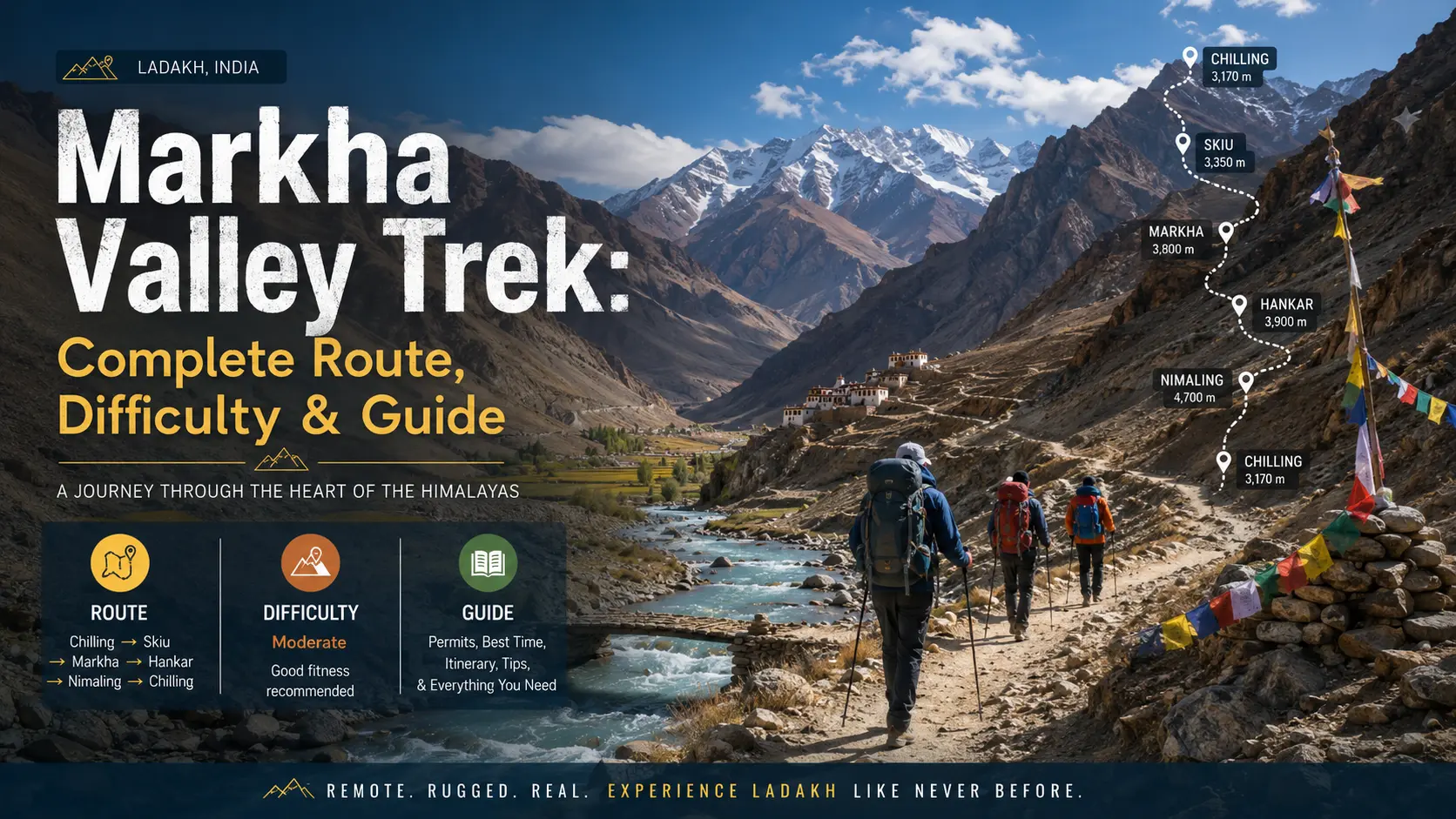
Markha Valley Trek at a Glance
Trek Detail | Practical Information |
Region | Ladakh, India |
Protected area | Hemis National Park |
Common starting point | Chilling |
Common endpoint | Shang Sumdo |
Typical trekking duration | 5–6 days |
Total trip from Leh | Usually 7–9 days with acclimatization |
Highest point | Kongmaru La, approximately 5,200 metres |
Difficulty | Moderate to challenging |
Main accommodation | Village homestays and basic camps |
Best general season | June to September |
Major highlights | Markha village, Hankar, Nimaling, Kang Yatse and Kongmaru La |
Distances, overnight stops and pass elevations can vary slightly between operators, maps and trail conditions. A Chilling-to-Hemis or Shang Sumdo itinerary is commonly described as approximately 78 kilometres, although shorter and longer versions are available.
Where Is Markha Valley Located?
A common question is, “Markha Valley is in which state?”
Markha Valley is in Ladakh, a Union Territory of India. It is not currently part of an Indian state. The valley lies within the wider Hemis National Park landscape, southeast of Leh, and the Markha River eventually joins the Zanskar River.
Leh is the main gateway for international and domestic travelers. Visitors generally fly or travel by road to Leh, acclimatize there, and then drive to a trailhead such as Chilling.
Why Trek Through Markha Valley?
The Ladakh Markha Valley Trek combines natural scenery with lived-in cultural landscapes. Instead of walking only through uninhabited wilderness, you pass villages where families cultivate small fields and host trekkers in traditional homes.
A Himalayan tea-house experience
Basic homestays are available in several settlements along the established route. This can reduce the amount of camping equipment you need, although comfort remains simple and availability may be limited during busy periods.
Expect shared rooms, floor bedding in some properties, basic wash facilities and home-cooked meals. Electricity, hot water and charging access should be treated as occasional conveniences rather than guaranteed services.
Views of Kang Yatse
Kang Yatse becomes one of the defining landmarks as the route enters the upper valley. Its snow-covered summit rises above the dry Ladakhi mountains and remains visible from several sections approaching Hankar and Nimaling.
Villages in a cold desert
Skiu, Markha and Hankar appear as green pockets between barren slopes. Irrigated fields, whitewashed chortens, prayer flags and small gompas give the route a strong sense of place.
Kongmaru La
Crossing Kongmaru La is the trek’s physical and visual climax. The approach is long and exposed, but clear weather may reveal extensive views over Kang Yatse, the Ladakh Range and surrounding valleys.
Markha Valley Trek Route Options
There are three widely discussed approaches:
Chilling to Skiu
This is the most practical option for many first-time visitors. You begin close to the Markha River and gain elevation more gradually than on routes that cross an additional high pass at the beginning.
Spituk route
The traditional Spituk approach is longer and may include Ganda La before descending toward Skiu. It provides a fuller trekking journey but adds distance, elevation and difficulty.
Stok route
Some itineraries approach through Stok and connect with the wider trail network. This option is better suited to properly acclimatized trekkers who want a longer and more demanding route.
For a balanced itinerary, Content Holidays recommends considering the Chilling–Skiu–Markha–Hankar–Nimaling–Kongmaru La–Shang Sumdo route. The final route should always be confirmed against current road access, river conditions and accommodation availability.
Markha Valley Trek Itinerary
The following itinerary covers five trekking days. Add at least two nights in Leh before departure, and consider an extra contingency day for weather or transport disruption.
Day 1: Leh to Chilling and Skiu
Travel by road from Leh toward Chilling, where the journey enters the Markha Valley trail system. The initial walk to Skiu follows a mixture of rough road and mountain trail above or beside the river.
This first day is relatively short, but it should not be underestimated. Even gentle climbing can feel tiring after arriving in Ladakh because Leh itself sits at roughly 3,500 metres.
Approximate trekking time: 3–5 hours
Overnight: Skiu homestay or campsite
Day 2: Skiu to Markha
This is usually one of the longest valley days. The trail follows the Markha River through dry canyons, small settlements and cultivated land.
Depending on water levels and the active trail alignment, trekkers may encounter bridge crossings, shallow wades or sections where the route has been altered by erosion. Trekking poles and secure footwear are valuable here.
Markha is one of the largest settlements on the route and normally offers several homestay choices.
Approximate trekking time: 6–8 hours
Overnight: Markha village
Day 3: Markha to Hankar
The scenery opens as you leave Markha and continue toward the upper valley. This stage may include river crossings and gradual climbs past small religious structures and settlements.
The first commanding views of Kang Yatse often appear around the Umlung-to-Hankar section. Hankar feels more isolated than Markha and sits among dramatic cliffs and high mountains.
Approximate trekking time: 4–6 hours
Overnight: Hankar or a nearby settlement
Day 4: Hankar to Nimaling
The route climbs away from the settled valley toward high grazing country. Vegetation becomes sparse, temperatures fall, and the altitude becomes more noticeable.
Nimaling is a broad high-altitude plateau used for seasonal grazing and trekking camps. It offers powerful views of Kang Yatse, but nights can be cold even during summer.
This is not the place to ignore a headache, unusual fatigue or nausea. Tell your guide immediately if you feel unwell.
Approximate trekking time: 5–7 hours
Overnight: Nimaling camp
Day 5: Nimaling to Kongmaru La and Shang Sumdo
The final major day begins with the climb to Kongmaru La. The ascent is demanding because of the elevation, cold wind and reduced oxygen.
After crossing the pass, the trail descends steeply through a narrow gorge toward Shang Sumdo. Loose ground can make the descent hard on the knees, so trekking poles are strongly recommended.
A vehicle normally collects trekkers from the roadhead for the return to Leh.
Approximate trekking time: 7–9 hours
Highest altitude: Approximately 5,200 metres
Overnight: Leh
Markha Valley Trek Difficulty
The Markha Valley Trek is best classified as moderate to challenging.
The trail is not technically difficult in normal summer conditions, but several factors increase its seriousness:
- Multiple days above 3,500 metres
- A pass of approximately 5,200 metres
- Long daily walking distances
- Cold nights and strong ultraviolet exposure
- River crossings and rough terrain
- Limited medical and evacuation access
- Basic accommodation and sanitation
A fit beginner may complete the trek with proper acclimatization, preparation and professional support. It is not a good choice for someone attempting their first long walk immediately after flying into Leh.
Recommended fitness preparation
Begin structured training six to eight weeks before departure. Combine brisk walking or running with stairs, leg-strength exercises and weekend hikes carrying a light backpack.
As a practical benchmark, Indiahikes recommends building toward running five kilometres in approximately 30 minutes, although personal health and trekking experience matter more than any single fitness test.
Acclimatization is non-negotiable
Spend at least two nights in Leh before beginning strenuous trekking. Use the first day for rest and the next for gentle local movement rather than an exhausting excursion.
Acute mountain sickness may cause headache, nausea, dizziness, fatigue or poor appetite after rapid ascent. Do not climb higher when symptoms are worsening. Confusion, loss of coordination or severe breathlessness require urgent descent and medical attention.
Travelers with heart, lung or other significant medical conditions should consult a qualified doctor before planning a high-altitude trek.
Markha Valley Trek Best Time and Weather
The normal trekking season runs from approximately mid-May to mid-September, with June to September offering the most dependable combination of accessible trails and operating homestays. Conditions remain changeable at altitude.
Period | Typical Conditions | Suitability |
Mid-May to June | Cold high sections; possible residual snow | Suitable with local confirmation |
July to August | Warmer days; stronger river flow possible | Popular trekking period |
September | Colder nights and often clearer autumn air | Excellent for prepared trekkers |
October to April | Snow, severe cold and reduced services | Not suitable for a standard trek |
Markha Valley weather changes quickly. Sunshine can feel intense during the day, while temperatures may fall below freezing around Nimaling at night. Carry warm insulation and waterproof protection regardless of the forecast.
Is the Markha Valley winter trek possible?
A Markha Valley winter trek is a specialist expedition, not a normal tea-house trek. Snow can cover the route, village accommodation may be unavailable, and the high-pass crossing can become hazardous. Winter travel should only be considered with experienced local leadership, expedition equipment and a flexible emergency plan.
Accommodation, Food and Facilities
Village homestays are part of the route’s appeal, but they are basic.
Meals commonly rely on locally available ingredients and simple trekking staples. Travelers with allergies, strict dietary restrictions or medical nutrition requirements should notify the operator in advance and carry suitable backup snacks.
Bring cash in Indian rupees because digital payments cannot be relied upon on the trail. Mobile service is limited or absent, and power banks are more useful than depending on charging facilities.
Waste disposal is another concern. Carry reusable bottles, avoid unnecessary packaged products and take non-biodegradable waste back to Leh.
Markha Valley Trek Cost
The Markha Valley trek cost depends on:
- Group size
- Number of trekking and acclimatization days
- Private or shared transport
- Guide and support-team requirements
- Homestay or camping arrangements
- Meals and equipment
- Emergency and evacuation support
- Travel season
- Hotel category in Leh
- Airport transfers and additional sightseeing
A low advertised price may exclude equipment, park charges, transport, guide fees or accommodation in Leh. Ask for a written inclusion-and-exclusion list before paying.
Content Holidays can prepare a customized quote based on your nationality, arrival date, group size, fitness level and preferred accommodation. International travelers should also budget separately for flights, travel insurance, visa expenses and personal equipment.
Can You Complete the Markha Valley Trek Solo?
Experienced trekkers sometimes complete the Markha Valley Trek independently during the main summer season, and the presence of villages makes it more accessible than completely uninhabited routes. However, a marked or previously used path does not make a high-altitude trek risk-free.
Solo trekking is not recommended for:
- First-time high-altitude trekkers
- Visitors unfamiliar with Ladakh
- Anyone traveling outside the main season
- Trekkers without navigation and emergency experience
- People with uncertain health or acclimatization
River levels, landslides, route diversions and weather can change conditions quickly. A local guide improves navigation, communication with hosts and emergency decision-making.
Essential Packing List
Bring a layered system rather than one heavy jacket:
- Broken-in trekking boots
- Trekking poles
- Moisture-wicking base layers
- Warm fleece or insulated mid-layer
- Down or synthetic insulated jacket
- Waterproof jacket and trousers
- Warm hat and sun hat
- Gloves
- UV-protection sunglasses
- High-SPF sunscreen and lip balm
- Refillable water bottles
- Water-purification method
- Headlamp with spare batteries
- Personal medication and first-aid supplies
- Power bank
- Cash
- Toilet paper and waste bags
- Travel-insurance details
Do not carry an unnecessarily heavy pack. Confirm what your trekking package provides before renting or purchasing equipment.
Responsible Trekking in Markha Valley
Markha Valley is both a protected mountain environment and a home for local communities.
Ask before photographing people, religious spaces or private homes. Dress respectfully in villages and monasteries. Use designated toilets where available, avoid contaminating water sources, and never leave batteries, wipes or plastic packaging behind.
Homestays can place tourism income directly within villages. Treat the accommodation as a family home rather than a hotel, and accept that water and fuel are limited resources at altitude.
Plan Your Markha Valley Trek with Content Holidays
A safe Markha journey begins before the trailhead. Content Holidays can help coordinate a route based on your available time, acclimatization needs, group size and preferred level of support.
Before confirming, request clear information about:
- Acclimatization nights in Leh
- Guide and support arrangements
- Accommodation and meal plan
- Transport to and from the trail
- Equipment supplied
- Emergency procedures
- Cancellation terms
- Exact inclusions and exclusions
Use the Content Holidays Leh Ladakh travel guide to begin planning your arrival, local transport and wider Ladakh itinerary.
Frequently Asked Questions
Is the Markha Valley Trek suitable for beginners?
A fit beginner can complete the trek with proper preparation, two or more acclimatization nights in Leh, and an experienced guide. However, its high altitude, long days and Kongmaru La crossing make it unsuitable for unprepared first-time hikers.
How many days are required for the Markha Valley Trek?
The main trek normally requires five to six walking days. Plan seven to nine days from Leh to Leh so that you have time to acclimatize and manage weather or transport delays.
What is the highest altitude of the Markha Valley Trek?
Kongmaru La is the trek’s highest point at approximately 5,200 metres, or around 17,000 feet. Published figures differ slightly depending on the map and measurement used.
Which month is best for the Markha Valley Trek?
July, August and early September are popular choices. June can also be suitable after the route opens, while September usually brings colder nights. Always verify current pass, river and homestay conditions before departure.
Do I need a guide for the Markha Valley Trek?
A guide may not always be a formal requirement for every traveler, but professional support is strongly recommended for international visitors, first-time high-altitude trekkers and anyone traveling near the edges of the normal season.
Are homestays available throughout the route?
Homestays are available in major villages such as Skiu, Markha and Hankar during the trekking season. Nimaling generally requires camp-based accommodation. Availability can change, so arrangements should be confirmed before departure.
Conclusion
The Markha Valley Trek is one of Ladakh’s most complete trekking experiences: culturally rich, visually dramatic and physically demanding without requiring technical mountaineering skills in normal summer conditions.
Its rewards come with real responsibilities. Acclimatize properly, train before traveling, use a route suited to your experience and never ignore altitude symptoms. With careful planning and reliable local support, the journey from Chilling through Markha and Nimaling to Kongmaru La can become the defining experience of a Ladakh visit.
Anzer Ahmad is a Kashmir-based travel expert and founder of Content Holidays, specializing in customized Kashmir and Leh Ladakh tour packages. With years of on-ground experience helping thousands of travelers explore the valleys of Gulmarg, Pahalgam, and Dal Lake, Ahmad brings firsthand knowledge and trusted guidance to every journey